
 home
home
 Published: Aug 02, 2026 01:01 PM
 Page View: 104
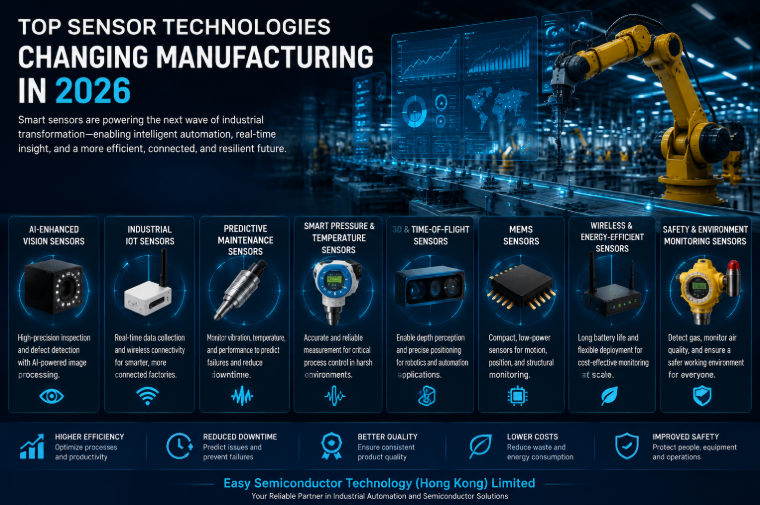
The global manufacturing industry is entering a new era of intelligent automation, driven by advanced sensor technologies that enable factories to become more connected, efficient, and adaptive. In 2026, sensors are no longer simple data collection devices. They have evolved into intelligent components capable of real-time analysis, predictive decision-making, and seamless integration with industrial control systems.
As manufacturers worldwide accelerate digital transformation, the demand for advanced sensing solutions continues to grow. From smart factories and industrial robotics to energy management and predictive maintenance, next-generation sensors are becoming a critical foundation for modern production environments.
Easy Semiconductor Technology (Hong Kong) Limited continues to support global industrial customers by providing reliable semiconductor components, automation solutions, and replacement technologies that help manufacturers upgrade their control systems and improve operational performance.
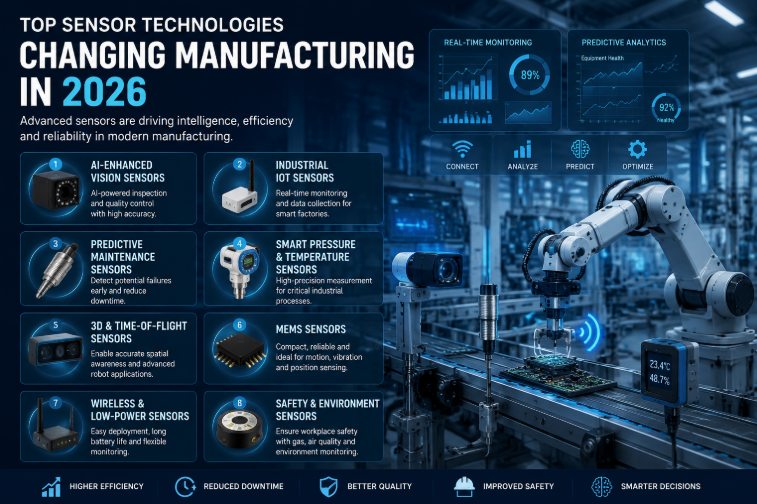
Traditional manufacturing relied heavily on manual inspection and basic monitoring systems. However, modern factories require faster response times, higher accuracy, and continuous optimization. Smart sensors provide manufacturers with detailed information about equipment conditions, production quality, environmental factors, and process efficiency.
By combining sensing technologies with industrial networks, edge computing, artificial intelligence, and industrial Internet of Things (IIoT) platforms, factories can monitor operations in real time and make data-driven decisions.
In 2026, sensor technologies are becoming a key driver for:
Improved production efficiency
Reduced equipment downtime
Higher product quality
Lower energy consumption
Enhanced workplace safety
More flexible manufacturing processes
Industrial vision sensors are becoming one of the fastest-growing technologies in automated manufacturing. Unlike traditional cameras, AI-powered vision systems can analyze images, identify defects, and make intelligent decisions without requiring constant human supervision.
In semiconductor manufacturing, automotive production, electronics assembly, and packaging industries, advanced vision sensors are being used for:
Surface defect detection
Component inspection
Precision measurement
Robot guidance
Quality control automation
With embedded AI processing, modern vision sensors can recognize complex patterns and adapt to changing production conditions. This allows manufacturers to improve accuracy while reducing inspection time.
Industrial IoT sensors are becoming essential building blocks for connected factories. These sensors collect real-time information from machines, production lines, and facility environments.
Common applications include:
Machine status monitoring
Temperature and humidity control
Energy consumption tracking
Production performance analysis
Remote equipment management
In 2026, wireless industrial sensors are gaining wider adoption because they simplify installation and allow manufacturers to monitor equipment in locations where traditional wiring is difficult.
Combined with cloud platforms and edge computing systems, IoT sensors enable factories to create complete digital representations of their production environments.
Unexpected equipment failures can cause significant production losses. Predictive maintenance sensors help manufacturers identify potential problems before breakdowns occur.
Modern sensors can monitor:
Vibration levels
Motor temperature
Pressure changes
Electrical performance
Mechanical wear
By analyzing this data with AI algorithms, manufacturers can predict equipment failures and schedule maintenance activities at the most suitable time.
This approach reduces downtime, extends equipment lifespan, and improves overall factory reliability.
Pressure and temperature monitoring remain essential in industries such as oil and gas, chemical processing, food manufacturing, and energy production.
The latest generation of sensors provides:
Higher measurement accuracy
Faster response times
Better resistance to harsh environments
Digital communication capabilities
Smart pressure and temperature sensors can directly communicate with PLC systems, SCADA platforms, and industrial networks, allowing operators to monitor critical processes more effectively.
Three-dimensional sensing technologies are transforming automation applications by providing accurate depth information and spatial awareness.
Time-of-flight (ToF) sensors and 3D sensing solutions are increasingly used in:
Robotic automation
Warehouse systems
Autonomous mobile robots
Precision assembly operations
These sensors allow machines to better understand their surroundings, improving safety and operational flexibility.
As factories move toward higher levels of automation, 3D sensing will play a major role in enabling intelligent robotic systems.
Micro-electromechanical system (MEMS) sensors continue to expand their role in industrial automation due to their compact size, reliability, and low power consumption.
MEMS technologies are widely used for:
Acceleration measurement
Motion detection
Equipment monitoring
Position sensing
Structural analysis
Their small form factor makes them suitable for modern industrial equipment where space efficiency and performance are important considerations.
Manufacturers are increasingly adopting wireless sensor networks to reduce installation costs and improve system flexibility.
New wireless sensor technologies provide:
Long battery life
Reliable industrial communication
Easy deployment
Remote monitoring capabilities
These solutions are especially valuable for large factories where thousands of monitoring points may be required.
The combination of wireless communication and low-power semiconductor technology is accelerating the development of smarter industrial environments.
Safety remains a major priority for industrial companies. Advanced sensors are helping factories create safer workplaces through continuous monitoring.
Applications include:
Gas detection
Air quality monitoring
Machine safety systems
Fire prevention
Environmental control
Smart safety sensors provide real-time alerts and help companies comply with increasingly strict industrial safety standards.
Behind every advanced sensor system are high-performance semiconductor components. Microcontrollers, communication chips, signal processing devices, power management components, and industrial-grade electronics are essential for reliable sensor operation.
As sensor technologies become more intelligent, manufacturers require semiconductor solutions that provide:
Higher processing capability
Greater reliability
Lower power consumption
Longer product availability
Industrial-grade durability
Easy Semiconductor Technology (Hong Kong) Limited focuses on supporting industrial customers with dependable semiconductor products and automation component solutions, helping companies maintain and upgrade critical manufacturing systems.
The manufacturing industry in 2026 is moving toward fully connected and intelligent production ecosystems. Sensors will continue to serve as the foundation for collecting valuable operational data and enabling smarter automation decisions.
Future developments will likely include:
More AI-powered sensing platforms
Greater integration between sensors and edge computing
Increased use of autonomous industrial robots
More intelligent energy management systems
Advanced digital twin applications
Companies that successfully adopt modern sensor technologies will gain significant advantages through improved productivity, reduced costs, and greater manufacturing flexibility.
Sensor technology is becoming one of the most important forces shaping the future of manufacturing. From AI vision systems and predictive maintenance sensors to industrial IoT devices and advanced semiconductor solutions, these technologies are transforming factories into smarter, more efficient, and more reliable environments.
As global industries continue their automation modernization journey, Easy Semiconductor Technology (Hong Kong) Limited remains committed to providing professional semiconductor support and industrial solutions that help customers achieve long-term manufacturing success.