
 home
home
 Published: Aug 06, 2026 10:53 AM
 Page View: 154
High-temperature industrial environments present some of the most demanding conditions for measurement and control systems. Industries such as chemical processing, oil and gas, power generation, metallurgy, semiconductor manufacturing, and advanced manufacturing require sensors that can operate accurately under extreme heat, vibration, pressure, and corrosive conditions.
As industrial automation continues to evolve, selecting the right high-temperature sensors has become a critical factor in improving operational efficiency, reducing downtime, and ensuring equipment safety. Easy Semiconductor Technology (Hong Kong) Limited highlights the importance of advanced sensor technologies that provide stable performance and long service life in challenging industrial applications.
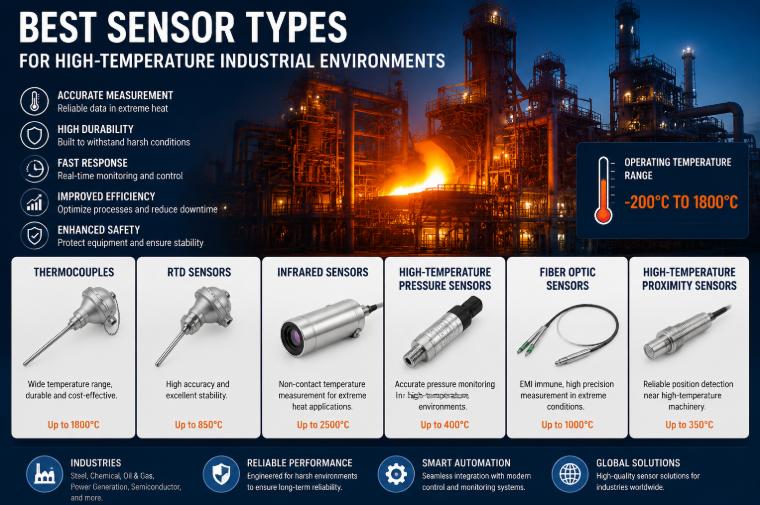
Sensors serve as the foundation of modern industrial control systems by collecting real-time data from production environments. In high-temperature applications, standard sensors often experience performance degradation, signal errors, or premature failure due to excessive heat exposure.
Reliable high-temperature sensors enable manufacturers to:
Monitor critical process conditions continuously
Improve equipment protection and safety
Optimize production efficiency
Reduce unexpected maintenance costs
Support predictive maintenance strategies
Enhance automation system accuracy
From monitoring furnace temperatures to controlling chemical reaction processes, high-quality sensors ensure that industrial systems operate within safe and efficient parameters.
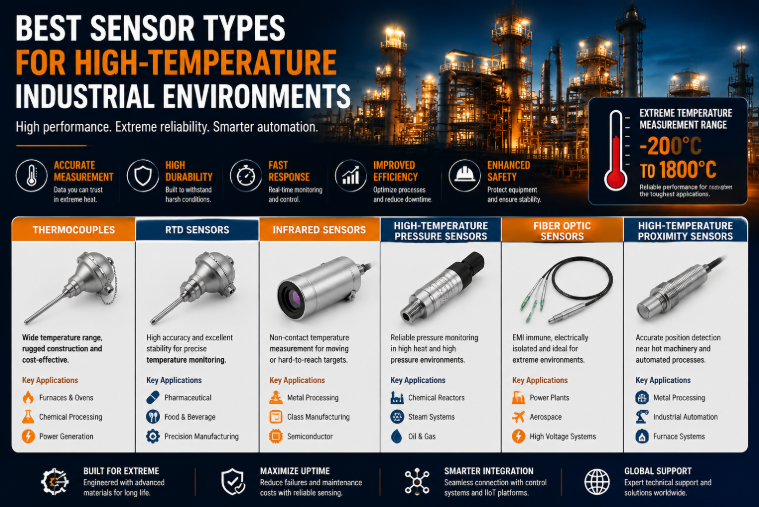
Thermocouples remain one of the most widely used temperature sensors in high-temperature industrial environments. They work by generating a voltage based on temperature differences between two different metals.
Key advantages include:
Extremely wide temperature measurement ranges
High durability in harsh environments
Fast response times
Resistance to mechanical stress
Cost-effective installation
Different thermocouple types are designed for specific applications. For example, Type K thermocouples are commonly used in general industrial heating systems, while Type R and Type S thermocouples are preferred for high-temperature applications such as furnaces and glass production.
Industries requiring continuous operation at elevated temperatures often choose thermocouples because of their proven reliability and simple maintenance requirements.
RTDs are another popular choice for industrial temperature measurement. Unlike thermocouples, RTDs measure temperature changes through variations in electrical resistance.
The most common material used in RTDs is platinum because of its excellent stability and accuracy.
Benefits of RTDs include:
Superior measurement precision
Excellent long-term stability
High repeatability
Low measurement errors
Although RTDs generally have lower maximum temperature limits compared with thermocouples, they are ideal for applications where accuracy is more important than extreme temperature capability.
Industries such as pharmaceutical manufacturing, food processing, and precision chemical production often use RTDs for reliable process monitoring.
Infrared sensors provide a valuable solution when direct contact with hot materials is impossible or unsafe. These sensors measure thermal radiation emitted from an object and convert it into temperature readings.
Advantages include:
Completely non-contact operation
Fast response speed
Ability to measure moving objects
Reduced sensor wear
Suitable for extremely high temperatures
Infrared sensors are widely used in steel manufacturing, metal processing, semiconductor production, and industrial furnaces.
For example, manufacturers can monitor molten metals or high-temperature surfaces without exposing sensors to damaging heat conditions.
Many industrial processes require simultaneous monitoring of temperature and pressure. High-temperature pressure sensors are designed to maintain accurate pressure measurements in environments where heat levels exceed normal operating conditions.
Typical applications include:
Chemical reactors
Steam systems
Gas processing equipment
Turbine systems
High-pressure manufacturing equipment
Modern high-temperature pressure sensors often use advanced materials and protective designs to improve durability against thermal stress and chemical exposure.
Fiber optic sensors are becoming increasingly important in industries requiring electromagnetic resistance and high-temperature performance.
Their advantages include:
Immunity to electromagnetic interference
Excellent performance in harsh environments
Small sensor size
Long-distance measurement capability
Fiber optic temperature sensors are particularly suitable for power plants, aerospace applications, and advanced manufacturing facilities where traditional electronic sensors may experience interference.
Industrial automation systems often require position detection near high-temperature machinery. Standard proximity sensors may fail when exposed to excessive heat.
High-temperature proximity sensors provide reliable detection for:
Metal processing equipment
Industrial robots
Automated production lines
Furnace systems
These sensors help maintain accurate machine positioning while improving automation reliability in extreme environments.
Choosing the correct sensor requires careful evaluation of several factors:
The sensor must support the maximum operating temperature of the application. Selecting a sensor with insufficient temperature capability can result in inaccurate readings and equipment failure.
Industrial environments may include:
Chemical exposure
Dust and particles
High pressure
Vibration
Electromagnetic interference
Sensors should be selected according to actual operating conditions.
Some applications require precise temperature control, while others prioritize durability and wide measurement ranges. Understanding process requirements helps determine the best sensor technology.
Long-lasting sensors reduce production interruptions. Industries should consider sensor lifespan, replacement difficulty, and overall maintenance costs.
As industries move toward intelligent manufacturing, high-temperature sensors are becoming more connected and intelligent. Future sensor technologies will increasingly integrate with industrial networks, edge computing platforms, and artificial intelligence systems.
Advanced sensors will support:
Real-time industrial data analysis
Automated process optimization
Predictive equipment maintenance
Improved energy efficiency
Enhanced production safety
The combination of advanced sensing technology and industrial automation will continue driving innovation across global manufacturing sectors.
High-temperature industrial environments require sensors that deliver reliability, accuracy, and long-term performance. Thermocouples, RTDs, infrared sensors, fiber optic sensors, pressure sensors, and high-temperature proximity sensors each provide unique advantages for different applications.
For industries seeking improved automation performance and operational safety, selecting the right sensor technology is essential. Easy Semiconductor Technology (Hong Kong) Limited continues to support industrial customers with reliable automation components and semiconductor solutions designed for demanding industrial environments.
By adopting advanced high-temperature sensor technologies, manufacturers can achieve greater efficiency, reduce risks, and build smarter, more resilient industrial systems for the future.