
 home
home
 Published: Jul 30, 2026 09:07 AM
 Page View: 160
In today’s rapidly evolving industrial environment, maintaining reliable process control systems is essential for improving productivity, reducing downtime, and ensuring operational safety. Many factories, power plants, chemical facilities, and manufacturing sites still rely on legacy Yokogawa control system modules that have operated successfully for decades. However, as these systems become older, challenges such as discontinued parts, limited technical support, increasing maintenance costs, and compatibility issues with modern automation platforms are becoming more common.
Easy Semiconductor Technology (Hong Kong) Limited provides professional solutions for replacing outdated Yokogawa control system modules, helping industries extend equipment life cycles while improving system reliability and performance.

Yokogawa has been a leading supplier of industrial automation and process control solutions for many years. Systems such as CENTUM series distributed control systems (DCS), PLC-related platforms, and industrial monitoring solutions have been widely used in industries including oil and gas, energy, chemical processing, water treatment, and manufacturing.
However, older Yokogawa modules may face several operational challenges:
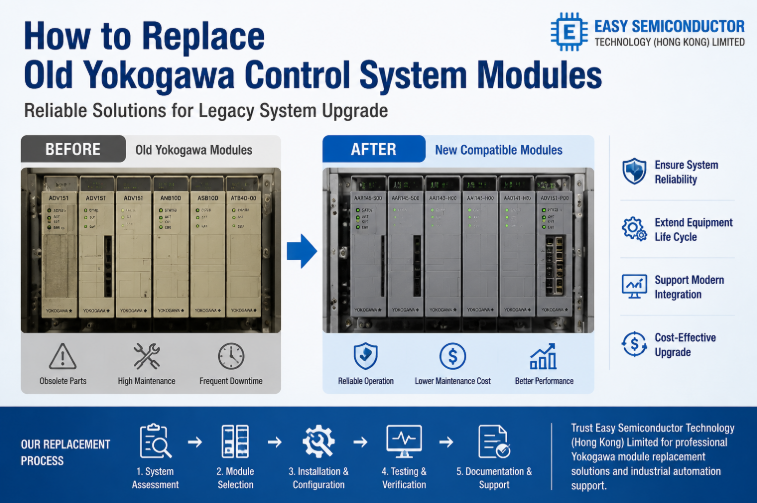
Many legacy Yokogawa I/O modules, communication cards, processor units, and power supply modules are no longer manufactured. When a critical module fails, finding an immediate replacement can become difficult, causing unexpected production interruptions.
As control system components age, failures become more frequent. Maintenance teams may spend significant time searching for spare parts, repairing obsolete hardware, or maintaining outdated engineering tools.
Older automation platforms may no longer receive official technical support or firmware updates. This creates challenges when companies need to integrate new equipment, upgrade communication networks, or meet modern industrial requirements.
Modern factories increasingly require advanced communication technologies, remote monitoring, cybersecurity protection, and data integration. Legacy Yokogawa modules may not easily support these new requirements without proper upgrade strategies.
Replacing old Yokogawa control modules requires careful planning to avoid production risks. Easy Semiconductor Technology (Hong Kong) Limited provides customized replacement solutions based on each customer’s existing automation environment.
Our replacement services include:
The first step is accurately identifying the existing hardware configuration, including:
Yokogawa system model and series
Module part numbers
Input/output specifications
Communication interfaces
Power requirements
Application environment
A detailed evaluation ensures that the replacement module meets the original system requirements.
Industrial control systems require precise compatibility. Selecting an alternative module involves checking:
Signal types (AI, AO, DI, DO)
Voltage and current ratings
Communication protocols
Installation requirements
Software compatibility
System configuration parameters
Easy Semiconductor Technology helps customers select suitable replacement modules to minimize engineering modifications.
After selecting the replacement module, proper installation and testing are critical. The replacement process generally includes:
Removing the obsolete module safely
Installing the new hardware
Checking wiring connections
Verifying communication status
Testing input/output signals
Confirming system operation
Comprehensive testing helps ensure stable operation before returning the system to production.
Replacing outdated Yokogawa modules provides several important advantages:
New replacement modules reduce the risk of unexpected failures caused by aging components, helping factories maintain continuous operation.
Having reliable replacement solutions available allows maintenance teams to respond quickly when failures occur, minimizing production losses.
A complete system replacement is not always necessary. Replacing selected obsolete modules can significantly extend the service life of existing Yokogawa control platforms.
Modern replacement solutions can provide improved compatibility with upgraded networks, industrial communication systems, and digital transformation projects.
Compared with replacing an entire DCS or automation system, module-level upgrades are often more economical and allow companies to maximize existing infrastructure investments.
Industrial facilities often require replacement solutions for various Yokogawa components, including:
Analog input modules
Analog output modules
Digital input modules
Digital output modules
Communication interface modules
CPU and controller modules
Power supply modules
Network interface cards
Remote I/O modules
Each application requires professional evaluation to ensure correct replacement selection.
A successful Yokogawa module replacement project should follow a structured approach:
Review the existing control architecture and identify aging components that require attention.
Develop a replacement plan including hardware selection, installation procedures, testing methods, and risk management.
Replace modules carefully while maintaining correct wiring, addressing, and system parameters.
Perform signal testing, communication verification, and operational checks.
Update system documentation, spare parts lists, and maintenance records for future management.
Easy Semiconductor Technology (Hong Kong) Limited specializes in providing industrial automation component solutions for global customers. With experience in supporting legacy automation systems, the company helps customers solve challenges related to obsolete hardware, emergency replacements, and industrial upgrades.
Our advantages include:
Professional knowledge of industrial control systems
Support for legacy automation equipment
Fast sourcing of discontinued modules
Technical assistance for replacement projects
Solutions designed for industrial reliability
We understand that automation systems are critical assets for industrial operations. Our goal is to help customers maintain stable production while gradually upgrading their automation infrastructure.
Replacing old Yokogawa control system modules is an effective way to improve reliability, reduce maintenance risks, and extend the operational life of industrial automation systems. Instead of replacing an entire control system immediately, targeted module replacement and modernization can provide a cost-effective upgrade path.
With professional support from Easy Semiconductor Technology (Hong Kong) Limited, industries can confidently manage legacy Yokogawa systems and prepare their automation platforms for future development.