
 home
home
 Published: Aug 24, 2026 11:54 AM
 Page View: 141
In modern industrial automation environments, spare parts management has become a critical factor affecting operational costs, production efficiency, and equipment reliability. As factories increasingly depend on automation systems, programmable logic controllers (PLCs), industrial computers, sensors, drives, communication modules, and control components, the cost of maintaining spare inventories continues to rise.
For many industrial companies, excessive spare parts inventory creates unnecessary capital investment, while insufficient spare availability can lead to costly production downtime. Finding the right balance has become an important challenge for automation engineers and facility managers.
Easy Semiconductor Technology (Hong Kong) Limited highlights that a systematic approach to spare parts management can significantly reduce costs while improving the reliability of industrial automation systems.
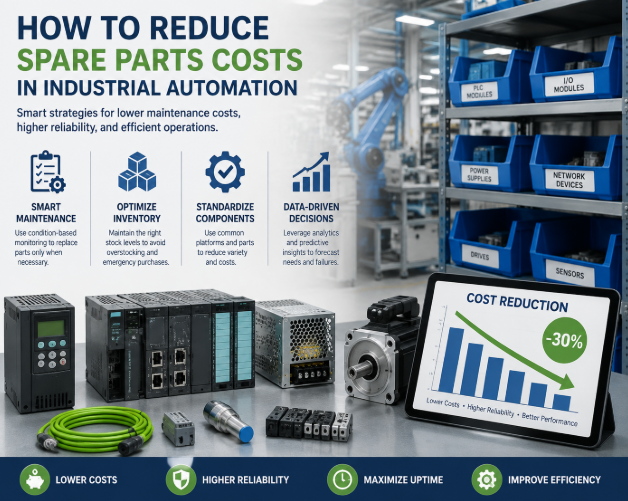
Spare parts expenses are influenced by several factors, including inefficient inventory planning, outdated equipment, poor maintenance strategies, and emergency purchasing requirements.
Many companies maintain large quantities of spare components because they fear unexpected failures. However, storing excessive numbers of replacement parts increases warehouse costs, creates inventory aging problems, and may result in obsolete components that are no longer compatible with upgraded automation systems.
Another common issue is the lack of standardization. Industrial facilities often operate different brands and generations of automation equipment, requiring multiple types of controllers, power supplies, communication modules, and electronic components. This diversity increases inventory complexity and makes spare management more difficult.
By analyzing equipment failure patterns and improving inventory control methods, companies can reduce unnecessary spare holdings while ensuring critical components are always available.
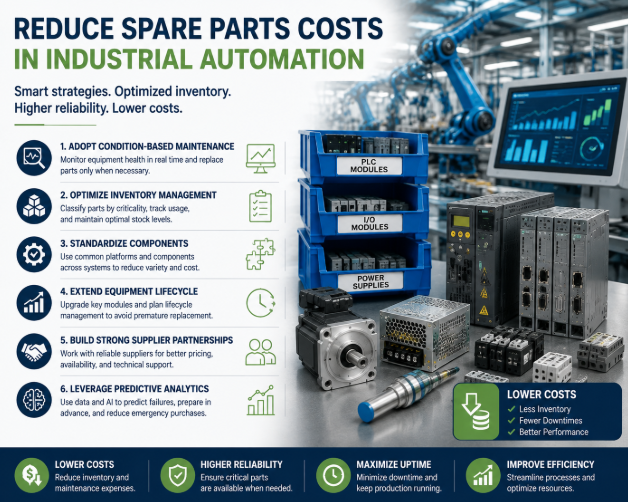
One of the most effective ways to reduce spare parts costs is adopting condition-based maintenance strategies. Traditional preventive maintenance schedules often require replacing components based on fixed time intervals, even when equipment remains in good condition.
With modern industrial monitoring technologies, companies can collect real-time operating data from automation systems. Sensors and industrial monitoring platforms can track temperature, vibration, electrical performance, communication status, and other key parameters.
By identifying early signs of equipment degradation, maintenance teams can replace components only when necessary. This approach reduces unnecessary part replacement, extends component life, and helps companies maintain a more accurate spare parts inventory.
Efficient inventory management is essential for controlling automation maintenance costs. Companies should classify spare parts according to their importance, usage frequency, and replacement difficulty.
Critical components that may stop production should receive higher priority. These may include PLC modules, industrial network switches, servo drives, safety controllers, and power supply units. Less critical components can be managed with lower inventory levels or purchased when required.
Using digital inventory management systems can also improve visibility. Automated tracking solutions allow maintenance teams to monitor stock levels, consumption history, supplier information, and equipment compatibility.
A data-driven inventory strategy helps companies avoid both overstocking and emergency purchases.
Standardization is another effective method for reducing spare parts costs. When industrial facilities use consistent equipment platforms, the number of required spare components can be significantly reduced.
For example, selecting common PLC families, communication interfaces, and power supply specifications across multiple production lines allows maintenance teams to share spare resources.
Standardization also simplifies technician training and reduces troubleshooting time. Engineers become more familiar with common system architectures, making repairs faster and more efficient.
Easy Semiconductor Technology (Hong Kong) Limited supports industrial customers by providing automation components and technical solutions that help organizations build more maintainable and cost-effective control systems.
Replacing entire automation systems due to discontinued components can create significant expenses. In many cases, targeted upgrades can extend equipment service life while reducing replacement costs.
Industrial facilities can modernize specific parts of a control system, such as communication modules, processors, human-machine interfaces (HMIs), or network infrastructure, instead of replacing complete systems.
Lifecycle management strategies help companies plan upgrades in advance, avoid unexpected failures, and reduce dependency on expensive emergency spare purchases.
Reliable supplier relationships play an important role in spare parts cost control. Working with experienced automation suppliers enables companies to access technical support, product availability information, and alternative replacement solutions.
A professional supplier can help identify compatible components, recommend cost-effective alternatives, and provide lifecycle information for automation products.
Long-term cooperation with trusted suppliers also improves procurement efficiency and reduces the risks associated with urgent sourcing during equipment failures.
The development of Industry 4.0 technologies provides new opportunities for reducing spare parts expenses. Predictive analytics platforms can analyze equipment data and forecast potential failures before they occur.
Artificial intelligence-based maintenance systems can identify abnormal operating patterns and recommend maintenance actions. This allows companies to prepare replacement components in advance instead of purchasing expensive parts during unexpected breakdowns.
Smart factory technologies are transforming spare parts management from a reactive process into a proactive strategy.
Emergency spare purchases are usually more expensive because companies may need immediate delivery, premium pricing, or expedited logistics services.
To minimize these costs, organizations should identify high-risk equipment and maintain appropriate safety stock levels. Critical automation components should be reviewed regularly based on production impact and failure probability.
A well-designed spare parts strategy ensures that essential components are available without creating excessive inventory expenses.
Reducing spare parts costs in industrial automation requires more than simply lowering inventory levels. Companies must combine intelligent maintenance strategies, inventory optimization, equipment standardization, lifecycle planning, and digital monitoring technologies.
By implementing effective spare management practices, industrial organizations can achieve higher equipment reliability, lower maintenance expenses, and improved production efficiency.
Easy Semiconductor Technology (Hong Kong) Limited continues to provide industrial automation solutions and component support services that help businesses optimize their control systems and build more efficient manufacturing environments.
Through smarter planning and advanced technologies, companies can reduce unnecessary spare parts costs while maintaining reliable and continuous industrial operations.