
 home
home
 Published: Aug 08, 2026 01:03 PM
 Page View: 171
In modern power generation, oil and gas, petrochemical, and heavy industrial facilities, turbines are among the most critical and valuable assets. Whether used for electricity production, mechanical drive applications, or large-scale processing systems, turbines operate under extreme speed, temperature, and load conditions. Even minor mechanical issues can lead to unexpected downtime, expensive repairs, and significant production losses.
A reliable vibration monitoring system is one of the most effective technologies for protecting turbine equipment. By continuously measuring vibration behavior, these systems help engineers detect early signs of mechanical problems, optimize maintenance schedules, and improve overall equipment reliability.
Easy Semiconductor Technology (Hong Kong) Limited provides professional industrial automation and control solutions, helping customers select suitable monitoring technologies for demanding industrial environments. This article explains the key factors engineers should consider when choosing vibration monitoring systems for turbines.
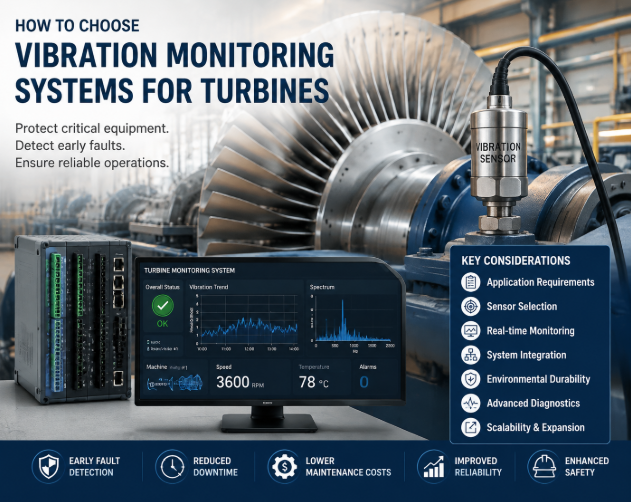
Turbines contain high-speed rotating components such as shafts, bearings, blades, and couplings. During normal operation, these components generate predictable vibration patterns. However, changes in vibration levels or frequency characteristics may indicate developing faults.
Common turbine problems detected through vibration monitoring include:
Shaft imbalance
Misalignment between rotating components
Bearing wear or damage
Rotor instability
Mechanical looseness
Blade defects
Lubrication problems
Foundation or structural issues
Without continuous monitoring, these problems may remain unnoticed until they cause serious equipment failure. A vibration monitoring system provides real-time condition information, allowing maintenance teams to take preventive action before failures occur.
The first step in selecting a vibration monitoring solution is understanding the specific application requirements. Different turbines have different operating conditions and monitoring needs.
Engineers should evaluate:
Turbine type and size
Rotational speed
Operating temperature
Environmental conditions
Criticality of the equipment
Required monitoring parameters
For example, large steam turbines in power plants may require comprehensive monitoring of shaft vibration, bearing vibration, rotor position, and speed measurements. Smaller industrial turbines may only require basic vibration analysis.
A clear understanding of operational requirements helps avoid selecting either an insufficient system or an unnecessarily complex solution.
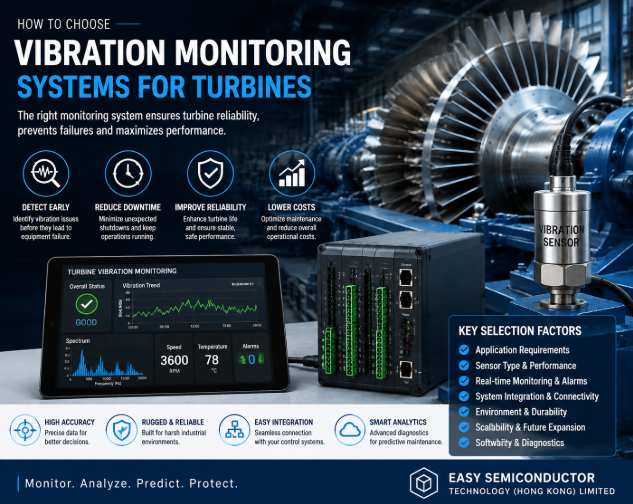
Sensors are the foundation of any vibration monitoring system. Choosing the correct sensor type directly affects measurement accuracy and reliability.
Common vibration sensors used in turbine applications include:
Accelerometers measure vibration acceleration and are widely used for general machine condition monitoring. They are suitable for detecting bearing problems, mechanical looseness, and high-frequency vibration issues.
Advantages include:
Wide frequency range
Easy installation
Reliable performance
Suitable for many industrial machines
Velocity sensors measure vibration speed and are commonly used for rotating machinery monitoring. They provide useful information about overall machine health and are often applied in industrial turbine systems.
For high-speed turbines, eddy current sensors are commonly used to measure shaft displacement directly. They provide accurate information about rotor movement and are essential for critical turbine protection systems.
When selecting sensors, engineers should consider:
Measurement range
Frequency response
Temperature resistance
Installation method
Signal compatibility
Industrial certifications
Modern turbine monitoring systems require continuous data collection and analysis. Real-time monitoring enables operators to identify abnormal conditions immediately and respond quickly.
Important features include:
Continuous vibration measurement
Real-time alarm notification
Trend analysis
Data recording
Remote access capability
Integration with control systems
Advanced systems can automatically compare vibration data against predefined limits and generate alerts when abnormal conditions occur.
For facilities operating 24/7, real-time monitoring significantly reduces the risk of unexpected shutdowns.
A vibration monitoring system should integrate smoothly with existing industrial automation infrastructure.
Important compatibility considerations include:
PLC integration
DCS communication
SCADA connectivity
Industrial Ethernet protocols
Analog signal interfaces
Digital communication standards
A well-integrated monitoring solution allows vibration data to become part of the overall plant management system, improving operational visibility.
Easy Semiconductor Technology (Hong Kong) Limited supports industrial customers with automation components and control solutions designed for reliable system integration.
Turbine environments can be extremely challenging. Monitoring equipment must withstand:
High temperatures
Strong mechanical vibration
Dust and contamination
Oil exposure
Electromagnetic interference
Humidity
When selecting equipment, engineers should review:
Protection ratings such as IP standards
Operating temperature range
Industrial certifications
Material quality
Long-term reliability
For harsh industrial locations, selecting rugged monitoring hardware is essential to maintain accurate performance over many years.
Basic vibration measurement provides useful information, but advanced diagnostic capabilities provide deeper insights into equipment condition.
Modern systems may include:
FFT vibration analysis
Frequency spectrum monitoring
Bearing condition analysis
Fault identification algorithms
Historical trend comparison
Predictive maintenance functions
These features help maintenance teams understand not only that a problem exists, but also why it is occurring.
By analyzing vibration patterns, engineers can schedule repairs more efficiently and reduce unnecessary maintenance activities.
Industrial facilities often expand over time. A vibration monitoring system should support future upgrades and additional monitoring points.
A scalable system allows customers to:
Add more sensors
Monitor additional turbines
Expand communication networks
Upgrade software functions
Connect with digital platforms
Choosing a flexible system reduces future investment costs and improves long-term value.
A properly selected vibration monitoring system provides many operational advantages:
Early detection of mechanical issues allows maintenance teams to repair problems before major failures occur.
Continuous monitoring helps prevent operation under harmful conditions, extending turbine service life.
Condition-based maintenance reduces unnecessary inspections and prevents expensive emergency repairs.
Monitoring abnormal vibration conditions helps protect personnel and equipment from catastrophic failures.
Stable turbine performance improves energy efficiency and overall plant productivity.
With the development of Industrial Internet of Things (IIoT), artificial intelligence, and smart manufacturing technologies, turbine monitoring systems are becoming more intelligent.
Future solutions will increasingly include:
Cloud-based monitoring platforms
AI-powered fault prediction
Wireless sensor networks
Digital twin technology
Automated maintenance recommendations
These technologies enable industries to move from traditional preventive maintenance toward predictive and intelligent maintenance strategies.
Selecting the right vibration monitoring system for turbines requires careful consideration of sensor technology, monitoring requirements, system integration, environmental conditions, and future expansion needs.
A reliable solution not only protects critical turbine assets but also improves operational efficiency, reduces downtime, and supports safer industrial production.
Easy Semiconductor Technology (Hong Kong) Limited is committed to providing high-quality industrial automation products and technical solutions for global customers. By helping industries implement advanced monitoring technologies, the company supports more reliable, efficient, and intelligent industrial operations.