
 home
home
 Published: Aug 08, 2026 12:48 PM
 Page View: 140
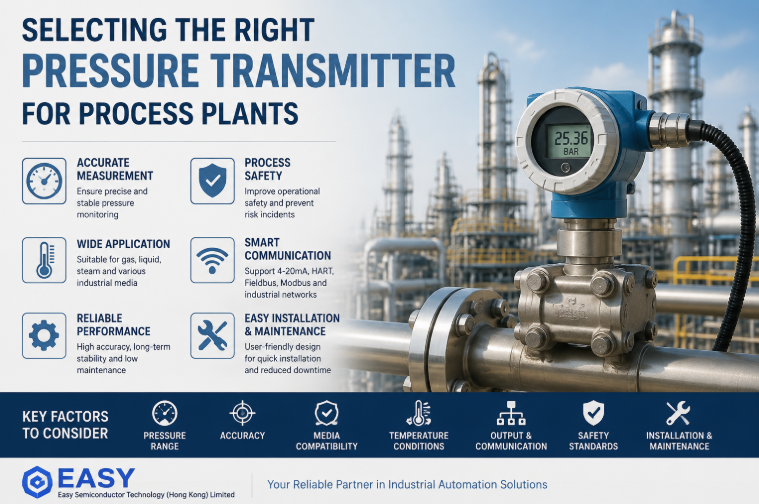
In modern process industries, accurate pressure measurement is essential for maintaining operational safety, improving production efficiency, and ensuring product quality. Pressure transmitters are widely used in chemical plants, oil and gas facilities, power generation, pharmaceutical manufacturing, water treatment plants, and other industrial applications. Selecting the right pressure transmitter is a critical decision because incorrect instrument selection can lead to inaccurate measurements, equipment damage, unexpected downtime, and increased maintenance costs.
Easy Semiconductor Technology (Hong Kong) Limited provides professional industrial automation solutions and supports global customers in selecting reliable control components, including pressure transmitters, sensors, PLC systems, industrial communication products, and automation equipment. Understanding application requirements is the first step toward choosing the most suitable pressure measurement solution.
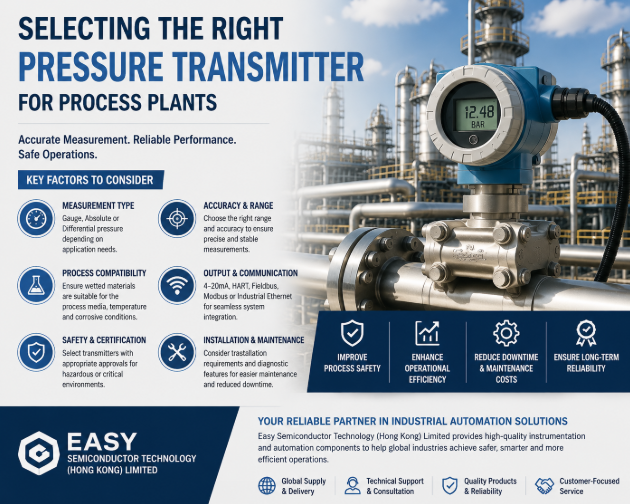
A pressure transmitter converts process pressure into an electrical signal that can be monitored and controlled by industrial control systems such as PLCs, DCS systems, and SCADA platforms. The output signal is typically a standard industrial signal, such as 4–20 mA, HART, Modbus, or other digital communication protocols.
In process plants, pressure transmitters are used for various measurement tasks, including:
Monitoring pipeline pressure
Controlling pumps and compressors
Measuring tank and vessel pressure
Detecting abnormal operating conditions
Supporting safety protection systems
Optimizing production processes
Different applications require different transmitter designs. Factors such as pressure range, process medium, temperature, environmental conditions, and communication requirements must all be considered before selection.
The first step in selecting a pressure transmitter is identifying the measurement type required by the process.
Gauge pressure transmitters measure pressure relative to atmospheric pressure. They are commonly used in applications such as:
Water supply systems
Hydraulic equipment
Pneumatic systems
General industrial pipelines
Absolute pressure transmitters measure pressure relative to a perfect vacuum. They are suitable for applications where atmospheric pressure changes may affect accuracy, including:
Vacuum systems
Distillation processes
Gas processing applications
Differential pressure transmitters measure the difference between two pressure points. They are widely used for:
Flow measurement
Filter monitoring
Level measurement in sealed tanks
Pressure drop detection
Choosing the correct measurement type ensures accurate process monitoring and prevents incorrect system operation.
Pressure range selection is one of the most important factors affecting transmitter performance. A transmitter should not operate continuously near its maximum pressure limit because this may reduce accuracy and shorten service life.
Engineers should consider:
Normal operating pressure
Maximum pressure conditions
Pressure fluctuations
Startup and shutdown conditions
For example, if a system normally operates at 50 bar, selecting a transmitter with a 0–60 bar range may provide better accuracy than choosing a 0–250 bar model.
Proper range selection improves measurement resolution and reduces unnecessary costs.
Industrial processes involve many different fluids and gases, including corrosive chemicals, high-temperature liquids, steam, and aggressive gases. The transmitter materials must be compatible with the measured medium.
Important material considerations include:
Stainless steel housing
Wetted diaphragm materials
Seal materials
Chemical resistance
Corrosion protection
For chemical plants, food processing facilities, and pharmaceutical applications, selecting suitable wetted materials is essential to prevent corrosion, contamination, and premature failure.
Temperature conditions can significantly affect pressure transmitter performance. Process plants often include extreme temperature environments, requiring transmitters designed for specific conditions.
Important considerations include:
Process temperature
Ambient temperature
Heat radiation exposure
Cooling requirements
For high-temperature applications such as steam systems or furnaces, remote diaphragm seals or cooling accessories may be required to protect the transmitter electronics.
Accuracy requirements depend on the importance of the measurement within the process.
For general industrial monitoring, standard accuracy may be sufficient. However, critical applications such as custody transfer, pharmaceutical production, and energy management require higher accuracy transmitters.
Common accuracy considerations include:
Reference accuracy
Long-term stability
Temperature compensation
Repeatability
Calibration requirements
A high-quality pressure transmitter can provide stable measurement performance over many years, reducing maintenance frequency and improving process reliability.
Modern process plants increasingly rely on digital communication and intelligent automation systems. The transmitter communication method should match the existing control infrastructure.
Common options include:
The traditional industrial standard offers:
High reliability
Long-distance transmission capability
Simple integration with PLC and DCS systems
HART enables digital communication over existing 4–20 mA wiring, allowing:
Remote configuration
Device diagnostics
Additional process information
Advanced plants may use communication technologies such as:
FOUNDATION Fieldbus
PROFIBUS
Modbus
Industrial Ethernet networks
Selecting the correct communication method ensures seamless integration with automation systems.
Many process plants operate in hazardous environments where explosive gases, vapors, or dust may exist. Pressure transmitters installed in these areas must meet relevant safety standards.
Common certifications include:
Explosion-proof certification
Intrinsically safe design
Industrial protection ratings
Applications in oil refineries, chemical plants, and natural gas facilities require careful evaluation of hazardous area classifications before installation.
A good pressure transmitter should not only provide accurate measurement but also simplify installation and maintenance.
Engineers should consider:
Connection size and type
Mounting location
Accessibility
Calibration requirements
Diagnostic functions
Smart transmitters with self-diagnostic capabilities can help identify problems before failures occur, reducing downtime and improving plant availability.
The performance of a pressure measurement system depends not only on the transmitter itself but also on supplier quality and technical support.
A reliable supplier should provide:
Genuine industrial products
Technical consultation
Application support
Product documentation
After-sales service
Easy Semiconductor Technology (Hong Kong) Limited works with international customers to provide professional automation component solutions and help industries select suitable products according to their operational requirements.
The development of smart manufacturing and Industrial Internet of Things (IIoT) is driving innovation in pressure measurement technology. Modern pressure transmitters increasingly feature:
Wireless communication
Remote monitoring
Predictive maintenance functions
Advanced diagnostics
Cloud connectivity
These technologies help factories improve efficiency, reduce operating costs, and achieve more intelligent process control.
Selecting the right pressure transmitter for process plants requires careful evaluation of measurement type, pressure range, process compatibility, temperature conditions, accuracy requirements, communication systems, and safety standards. A properly selected transmitter improves process reliability, enhances operational safety, and reduces long-term maintenance costs.
With professional experience in industrial automation solutions, Easy Semiconductor Technology (Hong Kong) Limited continues to support customers worldwide by providing reliable components and technical solutions for modern process industries. Choosing the right pressure measurement technology is an important step toward safer, smarter, and more efficient industrial operations.