
 home
home
 Published: Aug 08, 2026 12:44 PM
 Page View: 148
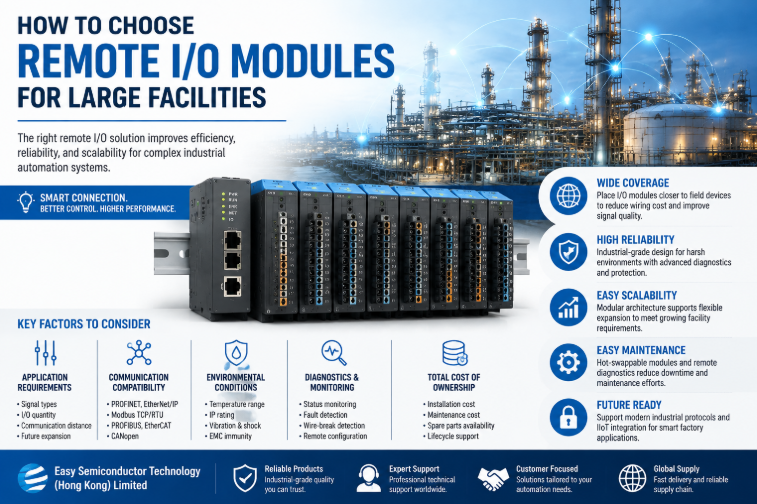
As industrial facilities continue to expand in scale and complexity, reliable data acquisition and control systems have become essential for maintaining operational efficiency, safety, and productivity. Large facilities such as manufacturing plants, chemical factories, power stations, oil and gas installations, water treatment plants, and smart buildings often contain thousands of field devices distributed across wide areas. In these environments, traditional centralized I/O architectures can create challenges related to wiring costs, installation complexity, signal reliability, and system scalability.
Remote I/O modules provide an effective solution by enabling field signals to be collected and transmitted closer to equipment locations while maintaining communication with centralized control systems such as PLCs, DCS platforms, and SCADA systems. Selecting the right remote I/O modules is a critical decision that directly affects system performance, maintenance efficiency, and future expansion capabilities.
Easy Semiconductor Technology (Hong Kong) Limited provides professional industrial automation solutions and supports customers in selecting reliable control components for demanding industrial applications. This article explains the key factors engineers should consider when choosing remote I/O modules for large facilities.
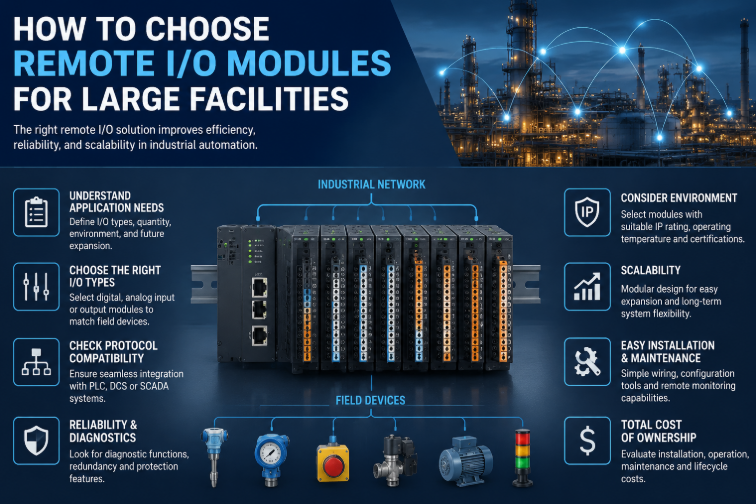
The first step in selecting remote I/O modules is understanding the specific requirements of the application. Different industries and facilities have different environmental conditions, signal types, and communication requirements.
Engineers should evaluate:
Number of field devices to be connected
Types of input and output signals
Required communication distance
Environmental conditions
Safety requirements
Future expansion plans
For example, a large manufacturing facility may require hundreds of digital inputs from sensors, switches, and safety devices, while a process plant may need extensive analog inputs for temperature, pressure, flow, and level monitoring.
A clear understanding of application requirements helps avoid overspending on unnecessary features while ensuring the selected modules can handle current and future operational demands.
Remote I/O modules are available with different signal configurations. Choosing the correct signal type is essential for accurate data collection and reliable equipment control.
Common I/O types include:
Digital input modules are used for receiving ON/OFF signals from devices such as:
Limit switches
Proximity sensors
Emergency stop buttons
Alarm contacts
Equipment status signals
Digital output modules control devices including:
Motors
Solenoid valves
Relays
Indicators
Actuators
Analog input modules measure continuous signals such as:
4–20 mA current signals
0–10 V voltage signals
Temperature transmitter outputs
Pressure transmitter signals
Analog output modules are commonly used for controlling:
Variable frequency drives
Control valves
Speed controllers
Process regulation systems
Selecting modules that match field device requirements ensures accurate operation and reduces signal conversion issues.
Communication capability is one of the most important considerations for remote I/O selection. Large facilities often integrate equipment from multiple suppliers, making protocol compatibility essential.
Popular industrial communication protocols include:
PROFINET
PROFIBUS
EtherNet/IP
Modbus TCP
Modbus RTU
EtherCAT
CANopen
The selected remote I/O modules should be compatible with the existing automation platform. For example, facilities using Siemens-based PLC systems may require PROFINET or PROFIBUS-compatible solutions, while systems based on Rockwell Automation platforms often use EtherNet/IP.
A suitable communication protocol improves system integration, reduces engineering time, and simplifies troubleshooting.
Large industrial facilities often expose automation equipment to challenging environments, including dust, vibration, humidity, temperature variations, and electromagnetic interference.
When selecting remote I/O modules, engineers should consider:
Protection rating (IP level)
Operating temperature range
Resistance to vibration and shock
Electrical noise immunity
Hazardous area certifications if required
For outdoor installations or harsh industrial environments, ruggedized remote I/O modules with higher protection ratings may be necessary.
Proper environmental selection helps extend equipment lifetime and prevents unexpected system failures.
Large facilities are constantly evolving. Production capacity may increase, new equipment may be installed, and additional monitoring points may be required.
A good remote I/O system should provide:
Flexible module expansion
Easy network integration
Support for additional channels
Simple configuration procedures
Long-term product availability
Modular remote I/O architectures allow companies to expand their automation systems without replacing existing infrastructure, reducing future investment costs.
Modern industrial automation systems require fast troubleshooting capabilities. Advanced remote I/O modules provide intelligent diagnostic functions that help maintenance teams quickly identify problems.
Useful diagnostic features include:
Channel status monitoring
Communication fault detection
Short-circuit protection
Wire-break detection
Power supply monitoring
Remote configuration capability
These features reduce downtime and improve maintenance efficiency, especially in large facilities where manual inspection of thousands of devices can be time-consuming.
For critical industrial applications, system availability is a top priority. Facilities such as power plants, chemical processing sites, and continuous production lines cannot tolerate frequent interruptions.
Important reliability features include:
Redundant communication networks
Dual power supply options
Hot-swappable modules
Fault-tolerant designs
Industrial-grade components
Choosing reliable remote I/O solutions helps maintain continuous operation and improves overall plant safety.
The lowest purchase price does not always represent the best solution. Companies should evaluate the total cost of ownership, including:
Installation costs
Wiring requirements
Engineering time
Maintenance expenses
Spare parts availability
Product lifecycle support
Remote I/O systems can significantly reduce wiring costs compared with traditional centralized systems because field devices can connect locally and communicate digitally over industrial networks.
A well-designed remote I/O architecture can deliver long-term savings while improving system performance.
Industrial automation is rapidly moving toward digitalization, Industrial Internet of Things (IIoT), and smart manufacturing. Remote I/O modules should support future technology development.
Important future-ready features include:
Ethernet-based communication
Cloud connectivity support
Edge computing integration
Advanced diagnostics
Cybersecurity capabilities
Selecting modern remote I/O technology helps companies prepare their facilities for future automation upgrades.
Choosing the right remote I/O modules for large facilities requires careful consideration of application requirements, signal types, communication protocols, environmental conditions, scalability, reliability, and long-term operating costs.
A properly selected remote I/O system improves automation efficiency, reduces installation complexity, enhances maintenance capabilities, and provides a flexible foundation for future expansion.
Easy Semiconductor Technology (Hong Kong) Limited is committed to supplying reliable industrial automation components and professional technical support for global customers. By helping industries select suitable remote I/O solutions, the company supports smarter, safer, and more efficient industrial operations.
For large-scale automation projects, selecting the right remote I/O architecture is not only a technical decision—it is a strategic investment in the future of industrial productivity.