
 home
home
 Published: May 08, 2026 09:33 AM
 Page View: 324
In modern industrial facilities, the Distributed Control System (DCS) serves as the core of process automation, ensuring stable production, precise monitoring, and safe plant operations. Whether in power generation, petrochemical processing, water treatment, pharmaceuticals, or manufacturing industries, a sudden DCS system shutdown can lead to serious production losses, safety risks, and costly downtime. For this reason, having a reliable emergency recovery solution for DCS system shutdown is essential for every industrial plant.
Easy Semiconductor Technology (Hong Kong) Limited provides professional industrial automation solutions and understands the critical importance of fast and effective DCS recovery strategies. This article explores the major causes of DCS shutdowns and presents practical emergency recovery methods to minimize operational disruption.
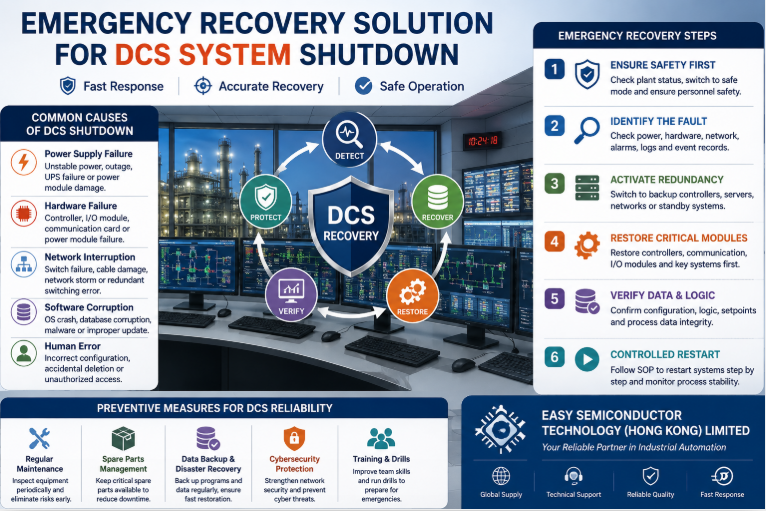
A DCS shutdown can occur for various reasons, including both hardware and software failures. Understanding the root causes is the first step toward effective recovery.
Unstable voltage, sudden power outages, UPS failure, or power module damage can immediately shut down DCS controllers, servers, and operator stations.
CPU modules, communication cards, I/O modules, and power modules may fail due to aging, overheating, electrical surges, or environmental factors such as humidity and dust.
DCS systems rely heavily on communication networks. Ethernet switch failure, fiber optic cable damage, redundant network switching errors, or network storms may trigger system-wide shutdowns.
Operating system crashes, database corruption, unauthorized software updates, or malware infections can cause DCS servers and engineering stations to stop functioning properly.
Incorrect configuration changes, accidental deletion of control logic, improper maintenance procedures, or unauthorized access may result in unexpected shutdowns.
When a DCS shutdown occurs, response speed and accuracy are critical. A structured emergency recovery process can significantly reduce downtime.
Before technical recovery begins, plant safety must be the top priority.
Operators should immediately verify the condition of critical equipment such as pumps, compressors, boilers, turbines, and safety valves. If necessary, switch to manual control mode or initiate emergency shutdown procedures according to plant safety protocols.
Safety interlock systems and emergency shutdown systems (ESD) must remain functional to prevent accidents.
Fast diagnosis helps avoid unnecessary downtime.
Engineers should check:
Power supply status
Controller LED indicators
Server and workstation alarms
Network switch conditions
UPS operation records
Event logs and alarm history
The goal is to determine whether the issue is caused by power, hardware, software, network, or external interference.
Most modern DCS systems are designed with redundancy.
These may include:
Redundant controllers
Dual power supplies
Backup servers
Redundant communication networks
Hot standby operator stations
Switching to backup systems can restore partial or full operation without complete shutdown. Regular testing of redundancy functions is essential to ensure reliability during emergencies.
Priority should be given to critical production units rather than restoring the entire system at once.
Focus first on:
Main controllers
Process safety systems
Key production lines
Alarm management systems
Historical data servers
This phased recovery strategy improves control efficiency and reduces restart risks.
After restarting controllers and servers, engineers must confirm that process data, control logic, and setpoints are correct.
Verification should include:
PID loop parameters
Alarm thresholds
Interlock logic
Historical trend data
Communication mapping
Field device status
Incorrect restoration can be more dangerous than delayed restoration.
System startup should follow the approved standard operating procedures (SOP).
Avoid sudden simultaneous startup of all field devices. Controlled restart helps prevent pressure surges, overload conditions, and process instability.
Close coordination between control room operators, maintenance teams, and field engineers is required.
Emergency recovery is important, but prevention is even more valuable.
Routine inspection of controllers, I/O modules, network devices, UPS systems, and cooling systems helps identify risks before failure occurs.
Keeping critical spare parts such as CPU modules, power supplies, communication cards, and switches available significantly shortens recovery time.
Regular backup of control programs, configuration databases, and historical records ensures fast restoration after software failures.
Firewalls, antivirus systems, access control, and software patch management help prevent cyberattacks and unauthorized system modifications.
Well-trained operators and engineers respond faster and make fewer mistakes during emergencies. Regular simulation drills improve readiness.
A DCS system shutdown can cause severe operational disruption, financial loss, and safety hazards in industrial plants. However, with a well-planned emergency recovery strategy, plants can significantly reduce downtime and restore operations safely.
From fault diagnosis and backup activation to controlled restart and preventive maintenance, every step plays a critical role in ensuring system resilience.
Easy Semiconductor Technology (Hong Kong) Limited remains committed to supporting industrial customers with reliable automation components, professional technical solutions, and fast-response services for DCS, PLC, SCADA, and industrial control systems worldwide.
In today’s highly automated industrial environment, preparation for DCS emergencies is not optional—it is a necessity for sustainable and safe plant operations.