
 home
home
 Published: Aug 08, 2026 12:41 PM
 Page View: 155
Industrial drive systems are essential components in modern manufacturing, process industries, energy facilities, and automated production environments. From controlling motors in conveyor systems to managing precision movement in advanced machinery, drive technology directly influences productivity, energy efficiency, equipment reliability, and operational safety.
Selecting the right industrial drive system requires more than simply choosing a motor controller with suitable power ratings. Engineers must evaluate application requirements, environmental conditions, communication standards, maintenance strategies, and future expansion needs. A well-designed drive system can significantly reduce operating costs, improve production performance, and extend equipment service life.
Easy Semiconductor Technology (Hong Kong) Limited provides professional industrial automation solutions and component supply services, helping global customers select reliable drive products for demanding industrial applications.
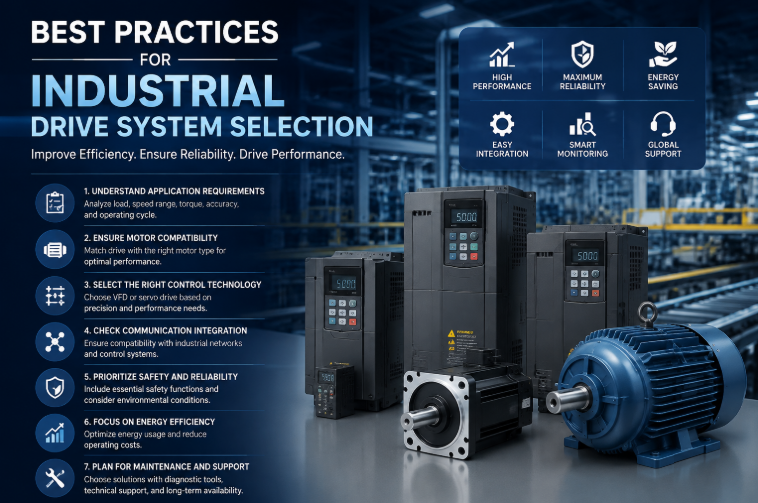
An industrial drive system typically consists of several key components, including motors, variable frequency drives (VFDs), servo drives, control systems, sensors, and communication networks. These components work together to regulate speed, torque, position, and energy consumption.
Different applications require different drive technologies. Variable frequency drives are commonly used for pumps, fans, compressors, and conveyors where speed control and energy savings are important. Servo drives are preferred for applications requiring high precision, such as robotics, CNC machines, packaging equipment, and semiconductor manufacturing systems.
Choosing the correct drive technology is the first step toward building an efficient and reliable automation system.
The most important step in drive selection is understanding the actual operating requirements of the application. Engineers should analyze:
Motor power and voltage requirements
Load characteristics
Required speed range
Starting torque requirements
Acceleration and deceleration performance
Operating cycle frequency
Precision and positioning accuracy
For example, a conveyor system in a warehouse may require stable speed control and long-term reliability, while a robotic assembly line requires fast response and accurate positioning.
Selecting a drive system based only on motor horsepower may result in poor performance, unnecessary energy consumption, or premature equipment failure.
Drive systems must be matched correctly with the motor type. Common industrial motors include induction motors, permanent magnet motors, synchronous motors, and servo motors.
Important considerations include:
Rated voltage and current
Motor efficiency class
Feedback requirements
Control method compatibility
Thermal performance
Advanced drive systems can optimize motor performance through technologies such as vector control, sensorless control, and automatic tuning. These features improve torque control, reduce energy losses, and enhance system stability.
Modern industrial drives provide multiple control options depending on application complexity.
For standard speed regulation applications, basic VFD control may be sufficient. However, high-performance applications often require advanced control methods, including:
Closed-loop speed control
Position control
Motion synchronization
Real-time feedback monitoring
Multi-axis coordination
Servo drive systems are widely used where precise motion control is critical. They provide rapid response, high accuracy, and excellent repeatability, making them suitable for industries such as electronics manufacturing, automotive production, and precision machinery.
Industrial automation systems increasingly rely on digital communication networks. Drive systems should support the communication protocols required by the existing control architecture.
Common industrial communication technologies include:
Industrial Ethernet
PROFINET
EtherNet/IP
Modbus TCP
CANopen
PROFIBUS
Integration with PLCs, HMIs, SCADA systems, and industrial IoT platforms enables real-time monitoring, remote diagnostics, and predictive maintenance.
A drive system with flexible communication capabilities can help companies upgrade their automation infrastructure in the future without major redesign.
Industrial environments can be challenging, with factors such as dust, moisture, vibration, chemicals, and extreme temperatures affecting equipment performance.
Before selecting a drive system, engineers should consider:
Protection rating requirements
Ambient temperature range
Cooling method
Installation location
Electrical noise conditions
For harsh industrial environments, drives with higher protection levels and robust construction are recommended. Proper environmental evaluation reduces downtime and improves long-term reliability.
Energy consumption is a major concern for industrial facilities. Motor-driven equipment often represents a significant portion of total electrical usage.
Modern drive systems improve energy efficiency by:
Adjusting motor speed according to demand
Reducing unnecessary mechanical losses
Optimizing acceleration and braking cycles
Supporting energy monitoring functions
Variable frequency drives are especially valuable in applications such as pumps and fans, where reducing motor speed can significantly lower energy consumption.
Energy-efficient drive selection not only reduces operational costs but also supports corporate sustainability goals.
Industrial safety is a critical factor in drive system design. Modern drives often include integrated safety functions such as:
Safe Torque Off (STO)
Safe Stop functions
Emergency shutdown support
Safety communication interfaces
These features help protect operators, reduce risks, and simplify compliance with international industrial safety standards.
Safety functions should be evaluated based on machine design requirements and applicable industry regulations.
A reliable drive system should support easy maintenance and long-term operation. Engineers should consider:
Availability of spare parts
Manufacturer technical support
Diagnostic functions
Firmware upgrade capability
Product lifecycle status
Drives with advanced monitoring capabilities can provide information about temperature, load conditions, operating hours, and potential faults. This allows maintenance teams to identify problems before unexpected failures occur.
The quality of the supplier is as important as the quality of the equipment. A professional industrial automation supplier can provide technical guidance, product selection support, and reliable after-sales service.
Easy Semiconductor Technology (Hong Kong) Limited focuses on supplying industrial automation components and control solutions for customers worldwide. With experience in industrial electronics and automation products, the company helps customers identify suitable solutions for different applications.
Reliable supply chains, product verification, and technical expertise are essential for successful industrial projects.
Selecting the right industrial drive system requires a comprehensive evaluation of application requirements, motor compatibility, control performance, communication capability, environmental conditions, safety requirements, and future expansion plans.
A properly selected drive system improves production efficiency, reduces energy consumption, increases equipment reliability, and supports the development of smarter industrial facilities.
As global industries continue moving toward automation and digital transformation, choosing reliable drive technologies has become a key factor in achieving competitive manufacturing performance.
Easy Semiconductor Technology (Hong Kong) Limited remains committed to providing high-quality industrial automation solutions and supporting customers in building efficient, reliable, and future-ready industrial systems.