
 home
home
 Published: Aug 03, 2026 01:36 PM
 Page View: 192
In modern process industries, uninterrupted operation is not just a business advantage—it is a critical requirement. Industries such as oil and gas, chemical processing, pharmaceuticals, water treatment, power generation, and food manufacturing rely on continuous automation systems to maintain safety, efficiency, and product quality. As industrial facilities become more connected and automated, the importance of reliable electrical infrastructure has grown significantly.
Easy Semiconductor Technology (Hong Kong) Limited highlights the increasing demand for redundant power systems as companies worldwide upgrade their industrial automation environments and strengthen operational resilience.
Process industries operate around the clock, with production systems often running continuously for days, months, or even years. Unlike traditional manufacturing environments where a temporary shutdown may only affect productivity, an unexpected power failure in a process plant can lead to equipment damage, safety risks, environmental incidents, and significant financial losses.
Industrial control systems, including programmable logic controllers (PLCs), distributed control systems (DCS), supervisory control and data acquisition (SCADA) platforms, industrial networks, and field devices, all depend on stable power supplies. Even a brief interruption can cause communication failures, process instability, or emergency shutdowns.
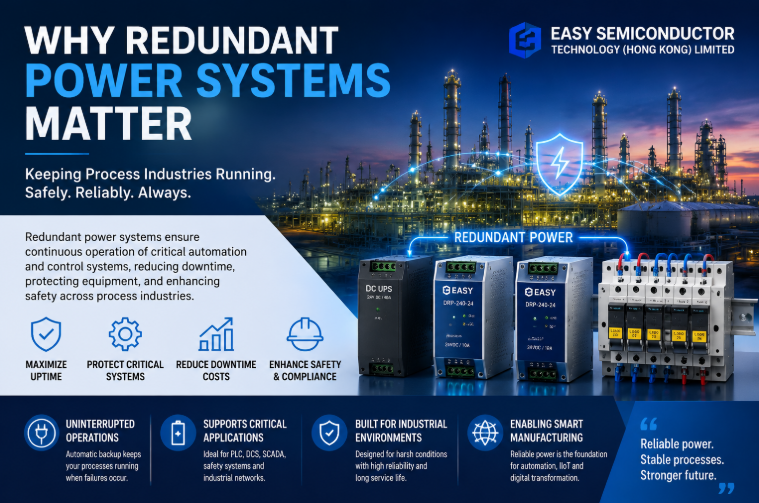
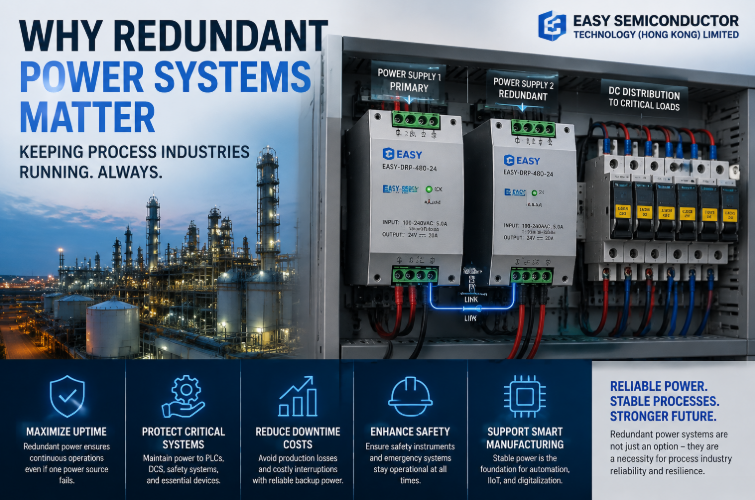
Redundant power systems provide an effective solution by ensuring that critical automation equipment continues operating even when one power source experiences a fault.
A redundant power system uses multiple power supply units or power paths to maintain continuous operation. Instead of relying on a single power source, the system is designed with backup capabilities that automatically take over when a primary component fails.
Common industrial redundancy configurations include:
N+1 Power Redundancy: One additional power module is installed beyond the required capacity, allowing the system to continue operating if one module fails.
Dual Power Supply Systems: Two independent power supplies provide continuous power to critical equipment.
Hot-Swappable Power Modules: Failed components can be replaced without shutting down the entire system.
Uninterruptible Power Supply (UPS) Integration: Battery-based backup systems provide temporary power during electrical disturbances.
These solutions are widely used in industrial automation cabinets, control rooms, remote monitoring stations, and critical infrastructure facilities.
Downtime remains one of the biggest challenges for process industries. A sudden power failure can stop production lines, interrupt chemical reactions, damage sensitive equipment, and require lengthy restart procedures.
For industries operating high-value production processes, every minute of downtime can create substantial losses. Redundant power systems reduce these risks by maintaining stable power availability and allowing operators to respond to failures without interrupting production.
By improving system availability, redundancy helps companies achieve higher productivity, better asset utilization, and more predictable operating costs.
Safety is a top priority in industries involving hazardous materials, high temperatures, high pressures, or complex chemical processes. Reliable power is essential for maintaining safety monitoring systems, emergency controls, sensors, and protective devices.
For example, a refinery or chemical plant depends on continuous operation of:
Pressure and temperature monitoring systems
Safety instrumented systems (SIS)
Emergency shutdown systems
Industrial communication networks
Alarm management platforms
A power interruption affecting these systems could create dangerous operating conditions. Redundant power architectures help ensure that safety-related equipment remains active during electrical failures.
The transition toward Industry 4.0 has increased dependence on digital technologies. Smart factories use advanced sensors, edge computing devices, industrial Ethernet networks, and cloud-connected platforms to collect and analyze real-time production data.
However, digital transformation also increases the need for dependable infrastructure. A connected factory cannot achieve intelligent operation if its automation systems are vulnerable to power interruptions.
Redundant power systems provide the foundation for:
Real-time industrial data collection
Predictive maintenance platforms
Automated production control
Remote equipment monitoring
Industrial IoT applications
As factories become more intelligent, power reliability becomes a key factor in maintaining digital performance.
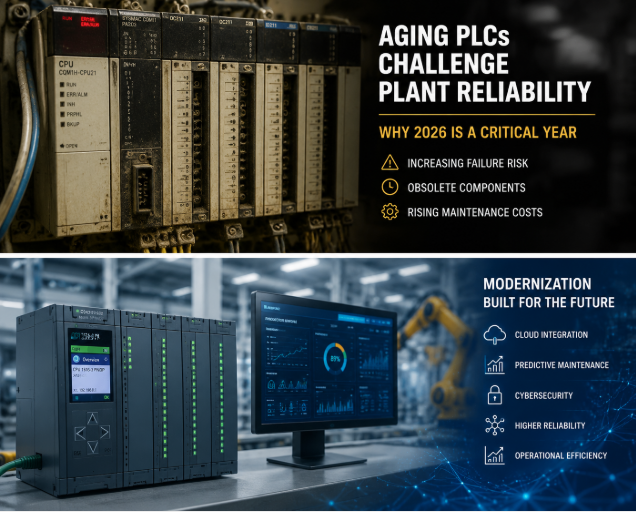
Many process plants continue to operate legacy automation systems that were installed decades ago. While these systems may still perform essential functions, aging power supplies and discontinued components can create reliability challenges.
Companies upgrading older facilities often focus on replacing outdated controllers, communication modules, and industrial power supplies. However, improving power architecture is equally important.
Modern redundant power solutions allow businesses to extend the service life of existing automation infrastructure while reducing the risks associated with aging electrical components.
Selecting an appropriate redundant power system requires careful consideration of operational requirements, environmental conditions, and future expansion plans.
Key factors include:
Power Capacity:
The system must provide sufficient power for all connected automation devices while maintaining backup capability.
Environmental Durability:
Industrial environments may involve vibration, temperature changes, dust, moisture, or electromagnetic interference. Power systems must be designed for harsh conditions.
Compatibility:
New redundant power modules should integrate smoothly with existing PLC cabinets, control systems, and industrial networks.
Maintenance Requirements:
Easy replacement, monitoring capabilities, and diagnostic functions help reduce maintenance time and improve operational efficiency.
As global industries continue adopting automation, artificial intelligence, and connected production technologies, reliable power infrastructure will become increasingly important.
Future industrial facilities will require power systems that offer higher efficiency, intelligent monitoring, predictive diagnostics, and seamless integration with automation platforms.
Redundant power systems are no longer considered optional backup solutions—they are becoming essential components of modern industrial reliability strategies.
Easy Semiconductor Technology (Hong Kong) Limited provides industrial automation components and replacement solutions designed to help businesses maintain reliable production environments. By supporting the supply of critical automation hardware, the company helps industries reduce downtime, improve system stability, and modernize aging infrastructure.
In process industries where continuous operation is essential, investing in redundant power systems represents a strategic approach to protecting productivity, safety, and long-term operational success.
About Easy Semiconductor Technology (Hong Kong) Limited
Easy Semiconductor Technology (Hong Kong) Limited specializes in industrial automation components, semiconductor solutions, and replacement services for global manufacturing and process industries. The company is committed to helping customers maintain reliable automation systems through high-quality products and professional technical support.