
 home
home
 Published: Aug 03, 2026 01:57 PM
 Page View: 183
In today’s highly competitive manufacturing environment, companies are under increasing pressure to improve efficiency, reduce downtime, and control operational expenses. Traditional maintenance strategies, such as reactive repairs after equipment failure or scheduled maintenance based only on time intervals, are no longer sufficient for modern industrial facilities. As factories become more automated and production systems become more complex, predictive maintenance is emerging as one of the most effective solutions for reducing production costs and maximizing equipment reliability.
Easy Semiconductor Technology (Hong Kong) Limited highlights that predictive maintenance technologies are helping manufacturers transform maintenance operations by using real-time data, advanced sensors, industrial communication systems, and intelligent analytics to identify potential equipment problems before failures occur. This proactive approach allows companies to avoid unexpected shutdowns, extend asset life, and save millions of dollars in production losses.
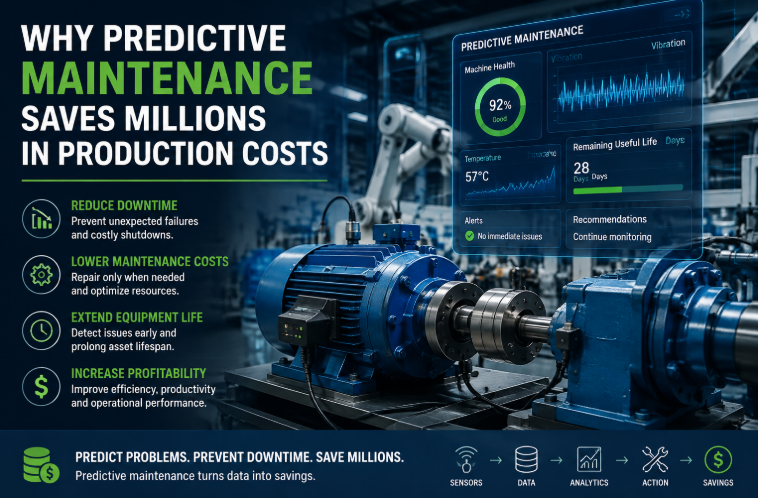
Unplanned equipment downtime is one of the biggest financial challenges faced by industrial manufacturers. A single failure in a critical production machine can interrupt entire production lines, delay customer deliveries, increase labor costs, and create additional expenses for emergency repairs.
In industries such as semiconductor manufacturing, automotive production, chemical processing, energy, and food manufacturing, even a short period of downtime can result in significant losses. Production equipment often operates continuously under demanding conditions, making early detection of mechanical, electrical, or operational issues essential.
Predictive maintenance helps companies move away from costly emergency repairs by continuously monitoring equipment conditions. Instead of waiting for a machine to fail, maintenance teams receive early warnings and can schedule repairs during planned production pauses.
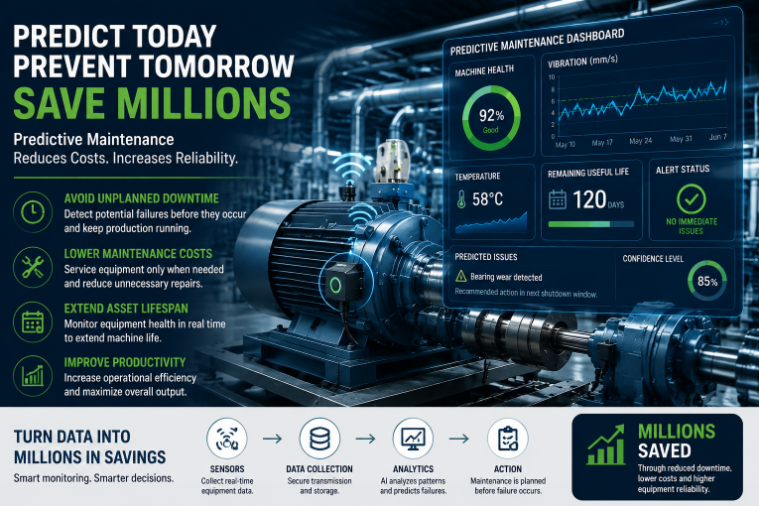
Predictive maintenance relies on a combination of advanced technologies designed to collect and analyze equipment data. Smart sensors installed on industrial machines monitor key parameters such as vibration, temperature, pressure, energy consumption, and operating performance.
Industrial control systems and communication networks transmit this information to monitoring platforms where intelligent software analyzes equipment conditions. By identifying abnormal patterns and performance changes, predictive maintenance systems can forecast possible failures before they happen.
For example, increased vibration levels in a motor may indicate bearing wear. A gradual rise in operating temperature may suggest cooling system problems. Changes in energy consumption may reveal equipment inefficiency. Detecting these signals early allows maintenance teams to take corrective action before a major breakdown occurs.
The greatest financial benefit of predictive maintenance is the significant reduction in unplanned downtime. When production equipment operates reliably, factories can maintain stable output levels and avoid costly interruptions.
Unlike reactive maintenance, where technicians must respond after equipment failure, predictive maintenance allows companies to plan maintenance activities according to actual equipment conditions. This improves workforce efficiency because maintenance teams can prepare tools, spare parts, and technical resources in advance.
For large-scale manufacturing facilities, reducing downtime by even a small percentage can create substantial cost savings. Higher equipment availability also enables factories to increase production capacity without investing heavily in additional machinery.
Industrial equipment represents a major investment for manufacturing companies. Without proper maintenance, machines may experience accelerated wear, reduced performance, and premature replacement requirements.
Predictive maintenance helps protect these investments by ensuring equipment operates under optimal conditions. Early identification of problems prevents minor issues from developing into serious failures that require expensive repairs or complete equipment replacement.
By extending machine lifespan, companies can achieve better returns on their capital investments while maintaining stable production performance over many years.
Traditional maintenance often involves replacing components according to fixed schedules, even when parts still have significant remaining service life. This approach can lead to unnecessary maintenance expenses and wasted resources.
Predictive maintenance uses real-time equipment data to determine when maintenance is truly required. This condition-based strategy reduces unnecessary inspections, minimizes spare-part consumption, and improves maintenance planning.
With accurate data analysis, companies can optimize inventory management by keeping essential spare parts available while avoiding excessive stock levels. These improvements contribute directly to lower operational costs.
As industries move toward digital transformation and smart manufacturing, predictive maintenance has become an important foundation of intelligent factory operations. Connected devices, industrial networks, cloud platforms, edge computing, and artificial intelligence technologies are enabling manufacturers to achieve greater visibility into production systems.
Modern smart factories require reliable automation systems that can operate efficiently with minimal disruption. Predictive maintenance provides the intelligence needed to maintain critical assets and support continuous production.
Easy Semiconductor Technology (Hong Kong) Limited recognizes that integrating advanced monitoring solutions with industrial automation infrastructure allows companies to improve reliability, productivity, and long-term competitiveness.
Equipment failures can create serious safety risks in industrial environments. Mechanical breakdowns, electrical faults, or process abnormalities may lead to dangerous situations for employees and damage to valuable assets.
Predictive maintenance improves workplace safety by identifying equipment problems before they become hazardous events. Early warnings allow operators to address potential risks through controlled maintenance procedures rather than emergency responses.
This proactive approach creates safer working conditions while reducing the financial impact of accidents and production disruptions.
The future of manufacturing will increasingly depend on intelligent maintenance strategies. Artificial intelligence, machine learning algorithms, digital twins, and advanced industrial sensors will continue to improve the accuracy of failure prediction and equipment optimization.
As production systems become more connected, predictive maintenance will provide manufacturers with deeper insights into operational performance. Companies that adopt these technologies will be better positioned to reduce costs, improve efficiency, and respond quickly to changing market demands.
Easy Semiconductor Technology (Hong Kong) Limited believes that predictive maintenance is not only a maintenance upgrade but also a strategic investment in the future of industrial competitiveness. By preventing failures before they occur, manufacturers can save millions in production costs while building more reliable, efficient, and sustainable operations.
Predictive maintenance is changing the way industries manage equipment reliability and production efficiency. By combining real-time monitoring, intelligent analysis, and proactive maintenance planning, manufacturers can significantly reduce downtime, lower repair expenses, extend equipment lifespan, and improve overall productivity.
For modern factories seeking long-term growth, predictive maintenance is becoming an essential technology that delivers measurable financial benefits. As industrial automation continues to evolve, companies that embrace predictive maintenance will gain a powerful advantage in reducing costs and achieving operational excellence.
About Easy Semiconductor Technology (Hong Kong) Limited
Easy Semiconductor Technology (Hong Kong) Limited provides industrial automation components, semiconductor solutions, control system products, and technology services to support global manufacturing industries. The company focuses on delivering reliable solutions that help businesses improve efficiency, upgrade industrial systems, and achieve smarter production environments.