
 home
home
 Published: Aug 17, 2026 06:46 PM
 Page View: 140
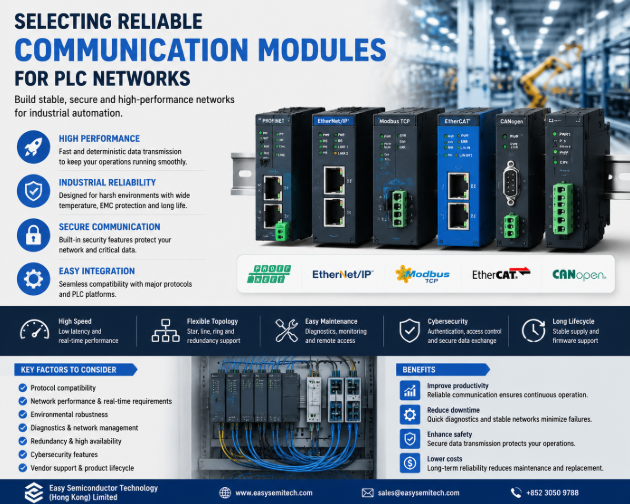
In today’s rapidly evolving industrial automation landscape, Programmable Logic Controllers (PLCs) serve as the core intelligence behind manufacturing lines, process control systems, smart factories, and critical infrastructure. However, the performance of a PLC system depends not only on the controller itself but also on the reliability of its communication network. Selecting the right communication modules is essential to ensure stable data exchange, minimize downtime, and support long-term industrial operations.
Easy Semiconductor Technology (Hong Kong) Limited recognizes that industrial communication requirements are becoming increasingly complex. Modern automation environments require communication modules that can deliver high-speed transmission, strong environmental resistance, protocol compatibility, cybersecurity support, and long lifecycle availability. Choosing reliable communication modules is therefore a strategic decision that directly impacts system efficiency and operational continuity.
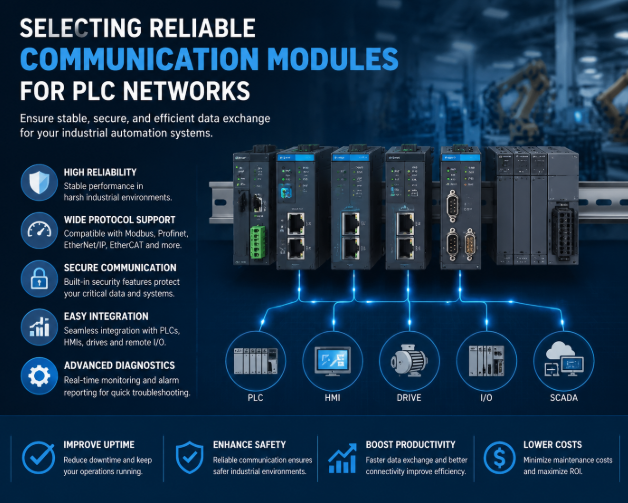
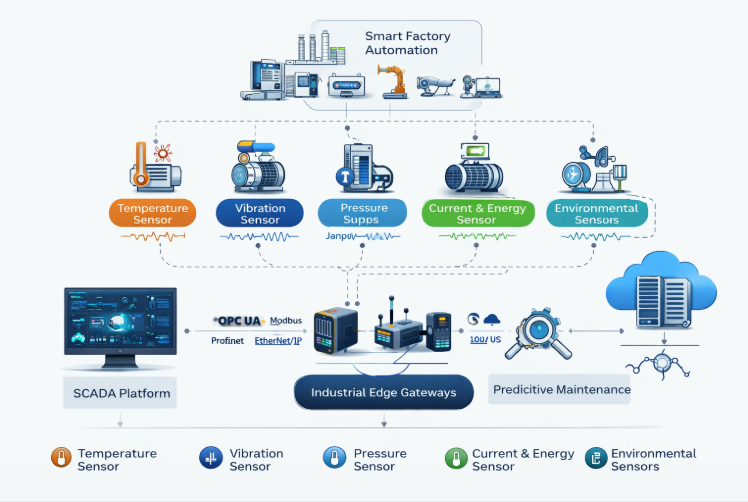
PLC communication modules act as the connection bridge between controllers, remote I/O devices, HMIs, industrial computers, sensors, drives, and enterprise-level systems. They enable real-time information exchange across automation networks and allow different devices from multiple manufacturers to work together efficiently.
As industries move toward Industry 4.0, smart manufacturing, and digital transformation, communication networks are expected to handle increasing amounts of operational data while maintaining deterministic performance. Production facilities can no longer rely on simple point-to-point connections. Instead, they require advanced industrial communication architectures based on technologies such as Industrial Ethernet, Modbus, PROFINET, EtherNet/IP, EtherCAT, CANopen, and other fieldbus solutions.
A communication module failure can interrupt production processes, delay maintenance operations, and create significant financial losses. Therefore, selecting high-quality and application-appropriate modules is one of the most important steps in designing a dependable PLC network.
The first consideration when selecting a PLC communication module is protocol compatibility. Different industries and automation platforms use different communication standards. A module must support the protocols required by the existing PLC architecture and future expansion plans.
For example, manufacturing environments may require PROFINET for Siemens-based automation systems, EtherNet/IP for Rockwell Automation platforms, Modbus TCP/RTU for general industrial applications, or EtherCAT for high-speed motion control systems.
Engineers should confirm:
Supported communication protocols
Master/slave or controller/device operating modes
Maximum supported nodes
Data transmission capacity
Firmware compatibility
Integration with existing engineering software
Selecting a module with broad protocol support can reduce future redesign costs and provide greater flexibility as automation systems evolve.
Not every industrial application requires the same communication performance. A packaging machine with synchronized motion control has very different requirements compared with a simple monitoring system.
Reliable communication modules should be evaluated based on:
Communication speed
Cycle time
Latency
Data processing capability
Deterministic communication performance
Network topology support
For high-performance automation applications, low latency and predictable communication timing are critical. A small communication delay may affect synchronization between drives, robots, and production equipment.
Modules designed for industrial networks should support stable operation under continuous workloads and provide consistent performance during peak data traffic conditions.
Industrial environments are significantly more demanding than commercial IT environments. PLC communication modules may operate under high temperatures, vibration, electrical noise, dust, humidity, and electromagnetic interference.
Reliable modules should provide:
Industrial temperature ratings
Strong EMC and EMI protection
Surge and ESD resistance
Reliable connectors
Long operational lifetime
Stable power management
Factories often operate 24 hours a day, seven days a week. Communication hardware must therefore be designed for continuous operation and harsh industrial conditions.
Choosing office-grade networking components for industrial applications can create unexpected failures and increase maintenance costs.
Modern PLC networks require more than simple data transmission. Advanced diagnostics help engineers quickly identify problems and maintain system availability.
High-quality communication modules should include:
Status indicators
Error reporting functions
Network monitoring capabilities
Remote diagnostics
Event logging
Firmware update support
Diagnostic capabilities reduce troubleshooting time by allowing maintenance teams to locate communication problems before they become major production failures.
A module that provides clear diagnostic information can significantly improve operational efficiency and reduce unplanned downtime.
For critical industries such as energy, transportation, water treatment, and large-scale manufacturing, communication availability is essential. Network failures may affect safety, productivity, and business continuity.
Reliable communication modules should support:
Redundant communication paths
Ring network architectures
Automatic failover mechanisms
Backup communication channels
Redundant network designs help maintain operation even when individual communication links or components experience failures. Industrial networks commonly use redundancy technologies to improve system availability and reliability.
When selecting modules for mission-critical applications, engineers should consider not only normal operation but also how the system responds during unexpected failures.
As industrial systems become more connected, cybersecurity has become an essential factor in communication module selection. PLC networks are increasingly connected with enterprise systems, cloud platforms, and remote monitoring solutions.
Reliable communication modules should support security features such as:
Secure authentication
Network segmentation
Access control
Encrypted communication where applicable
Secure firmware management
Cybersecurity protection helps prevent unauthorized access and ensures that industrial operations remain safe and reliable.
Industrial automation equipment often remains in service for ten, fifteen, or even twenty years. Therefore, long-term product availability and technical support are important considerations.
Before selecting a communication module, companies should evaluate:
Manufacturer reputation
Product lifecycle policy
Availability of replacement parts
Technical documentation
Firmware update support
Global supply capability
A reliable supplier can help customers maintain existing automation systems and reduce the risks associated with obsolete hardware.
Easy Semiconductor Technology (Hong Kong) Limited is committed to providing reliable semiconductor components, industrial automation products, and communication solutions for global customers. With growing demand for smart factories and connected industrial systems, selecting dependable communication modules has become a key factor in building efficient and sustainable automation infrastructures.
By focusing on protocol compatibility, industrial durability, network performance, diagnostics, security, and lifecycle support, companies can build PLC networks that deliver stable performance and long-term value.
The future of industrial automation depends on reliable communication. Choosing the right communication modules today helps organizations create smarter, safer, and more productive manufacturing environments tomorrow.
About Easy Semiconductor Technology (Hong Kong) Limited
Easy Semiconductor Technology (Hong Kong) Limited provides professional electronic components and industrial automation solutions to customers worldwide. The company specializes in supplying high-quality semiconductor products, automation components, and networking solutions to support industrial innovation and digital transformation.