
 home
home
 Published: Aug 17, 2026 06:53 PM
 Page View: 143
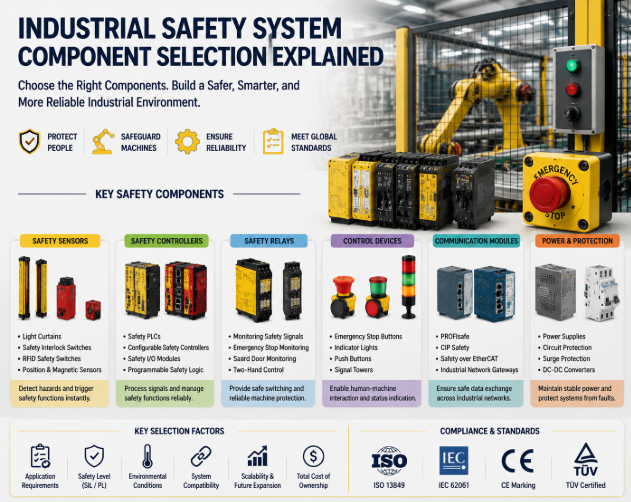
Industrial safety systems play a critical role in protecting personnel, equipment, and production environments across modern manufacturing facilities. As industrial automation continues to expand, selecting the right safety system components has become increasingly important for achieving reliable machine protection, operational efficiency, and compliance with international safety standards.
A well-designed industrial safety system is not only about stopping machinery during dangerous situations. It is a complete protection strategy that integrates safety controllers, sensors, relays, switches, communication modules, and control devices to monitor risks and respond quickly when abnormal conditions occur. Choosing the correct components ensures that safety functions operate accurately while minimizing unnecessary downtime.
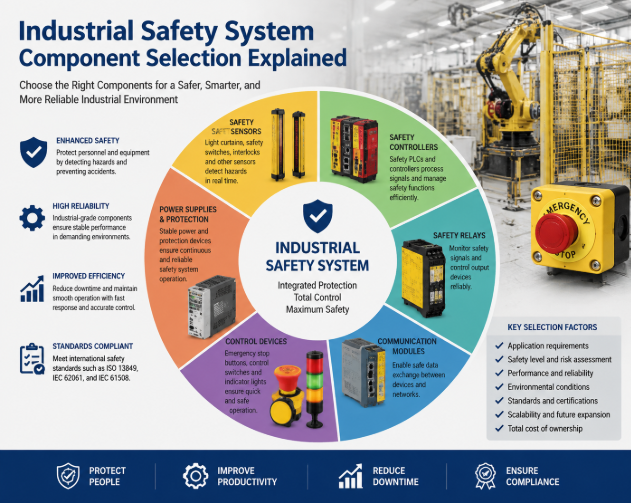
Before selecting safety components, engineers must first analyze the specific requirements of the industrial application. Different environments, such as automotive production lines, semiconductor factories, packaging systems, and process industries, have different safety challenges.
A comprehensive risk assessment should identify potential hazards, including:
Unexpected machine movement
Access to dangerous operating areas
Electrical hazards
Excessive temperature or pressure conditions
Emergency situations requiring immediate shutdown
The results of the risk assessment determine the required safety level, response time, and suitable component specifications. Standards such as ISO 13849, IEC 62061, and IEC 61508 provide guidelines for designing functional safety systems.
Safety sensors are essential components that detect dangerous conditions and provide signals to safety control systems. The correct sensor selection depends on the type of hazard and the required detection method.
Common industrial safety sensors include:
Safety light curtains create an invisible protective barrier using infrared beams. They are widely used around automated machinery, robotic cells, and assembly lines. When an object interrupts the beam, the system immediately sends a stop signal to prevent injury.
Important selection factors include:
Detection resolution
Protective field height
Operating range
Response time
Environmental resistance
Safety door switches monitor access points such as machine doors and protective covers. They prevent equipment operation when safety guards are open.
Modern safety interlock systems may include:
Mechanical locking functions
RFID-based identification
Guard locking monitoring
Diagnostic communication features
These devices are especially valuable in applications where operators frequently access machine areas.
Emergency stop buttons are fundamental safety components used across industrial environments. They must provide immediate machine shutdown capability and remain easily accessible during operation.
Key considerations include:
Contact reliability
Mechanical durability
Reset functions
Environmental protection ratings
Safety relays and safety controllers are the central processing elements of many industrial safety systems. They evaluate input signals from safety devices and control output devices such as contactors, drives, and actuators.
Safety relays are suitable for smaller machines or applications requiring simple safety functions. They provide reliable monitoring of emergency stops, safety switches, and light curtains.
When selecting a safety relay, engineers should consider:
Number of safety input channels
Output contact configuration
Response time
Diagnostic functions
Reset modes
For complex automation systems, safety controllers provide advanced monitoring and flexible configuration. They can manage multiple safety zones and communicate with industrial networks.
Advantages include:
Programmable safety logic
Network communication capability
Real-time diagnostics
Reduced wiring complexity
Easier system expansion
Safety controllers are commonly used in large production facilities where multiple machines and safety devices must work together.
Modern factories increasingly rely on industrial networks to exchange safety-related information. Safety communication modules enable secure data transmission between safety devices, controllers, and automation systems.
Popular industrial safety communication technologies include:
PROFIsafe
CIP Safety
Safety over EtherCAT
When selecting communication modules, important factors include:
Network compatibility
Data transmission reliability
Cybersecurity features
Diagnostic capabilities
System scalability
Reliable communication ensures that safety systems can quickly detect failures and maintain safe operating conditions.
A stable power supply is essential for industrial safety systems. Voltage fluctuations or power failures can compromise safety functions and lead to unexpected equipment behavior.
Safety system power components should provide:
Stable voltage output
Short-circuit protection
Overload protection
High reliability in industrial environments
Additional protection components such as surge suppressors and circuit protection devices help improve system availability and extend equipment lifespan.
Industrial environments can be challenging, with factors such as dust, moisture, vibration, extreme temperatures, and electromagnetic interference. Components selected for safety applications must be designed to withstand these conditions.
Engineers should review:
IP protection ratings
Operating temperature range
Mechanical resistance
Chemical compatibility
Certification requirements
For harsh industrial environments, ruggedized safety components can significantly improve long-term reliability.
Industrial safety components must comply with relevant international standards to ensure reliable protection. Certifications demonstrate that products have been tested and evaluated according to strict safety requirements.
Common certifications include:
CE marking
UL certification
TÜV approval
SIL ratings
Performance Level (PL) classifications
Selecting certified components helps manufacturers meet regulatory requirements while improving workplace safety.
The best industrial safety solution is not always the most expensive one. Effective component selection requires balancing safety performance, system complexity, maintenance requirements, and total ownership cost.
A well-designed safety system should provide:
Maximum personnel protection
Reliable machine operation
Easy maintenance
Future expansion capability
Reduced production interruptions
Working with experienced automation suppliers can help companies identify suitable components and avoid unnecessary system complexity.
Industrial safety system component selection is a crucial step in designing reliable and efficient automation environments. From safety sensors and emergency stop devices to safety controllers and communication modules, every component contributes to the overall protection strategy.
By carefully evaluating application requirements, environmental conditions, safety standards, and system scalability, manufacturers can build robust safety solutions that protect workers while maintaining high productivity.
Easy Semiconductor Technology (Hong Kong) Limited provides professional industrial automation components and technical solutions to support companies in developing reliable, efficient, and safe industrial control systems. With quality products and industry expertise, businesses can improve operational safety and achieve long-term automation success.