
 home
home
 Published: Aug 01, 2026 01:23 PM
 Page View: 164
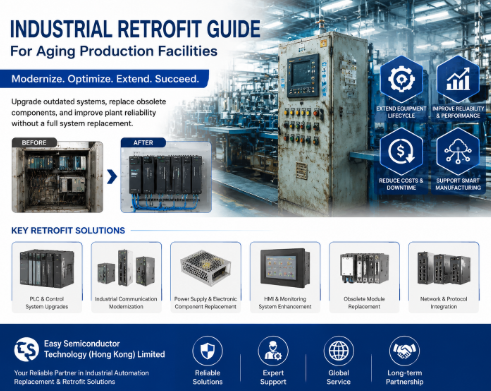
As global manufacturing industries continue to pursue higher efficiency, improved reliability, and smarter production capabilities, many companies are facing a common challenge: how to modernize aging production facilities without replacing entire automation systems. Industrial retrofit solutions have become a practical and cost-effective approach, allowing manufacturers to upgrade outdated equipment while preserving valuable infrastructure investments.
Easy Semiconductor Technology (Hong Kong) Limited highlights that industrial retrofit strategies are becoming increasingly important across industries such as semiconductor manufacturing, energy, petrochemical, automotive, pharmaceutical, and process automation. By replacing obsolete components, upgrading control architectures, and integrating modern technologies, factories can extend equipment lifecycles while improving operational performance.
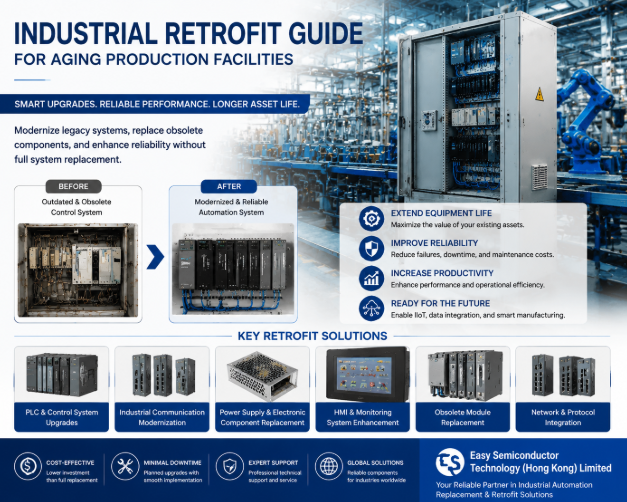
Many production facilities worldwide were built decades ago and continue to rely on automation systems that were designed for earlier generations of industrial operations. Although these systems remain functional, they often face challenges including discontinued components, limited technical support, outdated communication protocols, and difficulties integrating with modern industrial networks.
Legacy automation hardware such as PLC modules, industrial controllers, power supplies, communication interfaces, relay systems, and monitoring equipment may become difficult to maintain as original manufacturers discontinue older product lines. Unexpected failures can lead to production interruptions, increased maintenance costs, and extended equipment downtime.
Instead of completely replacing a production system, industrial retrofit provides manufacturers with a flexible pathway to improve reliability while maintaining existing mechanical structures, production processes, and operational knowledge.
Industrial retrofit refers to the process of upgrading existing industrial equipment and automation systems by replacing outdated components with newer, compatible technologies. Unlike complete system replacement, retrofit projects focus on targeted improvements that deliver maximum value with minimal disruption.
A successful retrofit strategy typically includes:
Assessment of existing automation infrastructure
Identification of obsolete or high-risk components
Selection of compatible replacement solutions
Hardware and software modernization
Testing and commissioning
Long-term maintenance planning
This approach enables factories to gradually transition toward modern automation environments while reducing capital investment requirements.
One of the biggest challenges in aging facilities is the availability of discontinued industrial components. Many older control modules, interface boards, industrial power supplies, and communication devices are no longer manufactured.
Easy Semiconductor Technology (Hong Kong) Limited provides replacement support for various industrial automation components, helping customers identify suitable alternatives for obsolete equipment. Through professional sourcing and technical evaluation, manufacturers can reduce risks associated with aging hardware.
Replacing critical components before failure occurs allows factories to avoid emergency shutdowns and maintain stable production schedules.
Programmable Logic Controllers (PLCs) are the core of many industrial automation systems. However, older PLC platforms may have limited processing capabilities, outdated programming environments, and restricted communication functions.
A retrofit project can involve upgrading PLC hardware, replacing outdated I/O modules, or integrating modern controllers with existing field equipment. This allows manufacturers to improve system responsiveness, expand monitoring capabilities, and prepare production lines for future digital transformation.
Modern factories depend on reliable communication networks to connect machines, sensors, controllers, and enterprise systems. Aging facilities often use legacy communication technologies that limit data exchange and system integration.
Industrial retrofit projects can introduce modern communication solutions, including updated industrial gateways, network modules, and protocol conversion technologies. These improvements enable better equipment connectivity and support Industry 4.0 initiatives such as real-time monitoring and predictive maintenance.
Industrial power systems require high reliability because unstable power conditions can affect sensitive automation equipment. Aging power supplies, control boards, and electronic modules may become major failure points.
Replacing outdated power-related components with reliable alternatives helps improve system stability and reduces unexpected downtime. Proper component selection also ensures compatibility with existing industrial environments.
A complete factory automation replacement can require significant financial investment, long engineering cycles, and production interruptions. Retrofit solutions provide a more economical alternative by upgrading only essential areas.
Manufacturers can achieve modernization goals while maximizing the value of existing equipment.
Many industrial machines are mechanically robust and capable of operating for many additional years. The main limitation is often outdated control electronics rather than the machine structure itself.
Through targeted retrofits, companies can extend the service life of production assets and delay expensive replacements.
Modern replacement components can reduce failure risks and simplify maintenance operations. Updated systems often provide improved diagnostics, easier troubleshooting, and better availability of spare parts.
This allows maintenance teams to move from reactive repairs toward proactive equipment management.
Industrial retrofit is an important step toward smart manufacturing. By upgrading automation hardware and communication capabilities, factories can gradually introduce advanced technologies such as industrial IoT, data analytics, remote monitoring, and intelligent production management.
To maximize retrofit results, manufacturers should consider several key factors:
Evaluate System Conditions Before Upgrading
A detailed assessment of existing hardware, software, and production requirements is essential before selecting replacement solutions.
Prioritize Critical Equipment
Not every component requires immediate replacement. Companies should focus on high-risk equipment that could significantly impact production reliability.
Ensure Compatibility and Integration
Replacement components must work effectively with existing systems, including controllers, networks, sensors, and operator interfaces.
Plan Future Expansion
Modernization should not only solve current problems but also create opportunities for future upgrades and digital transformation.
Work with Experienced Technology Partners
Professional support helps companies select appropriate replacement solutions, reduce integration risks, and improve project efficiency.
Easy Semiconductor Technology (Hong Kong) Limited is committed to supporting global customers with industrial automation replacement solutions and electronic component services. The company focuses on helping manufacturers overcome challenges caused by obsolete equipment and aging automation infrastructure.
With expertise in industrial components, automation systems, and replacement strategies, Easy Semiconductor Technology (Hong Kong) Limited assists customers in maintaining operational continuity while moving toward more reliable and efficient production environments.
As global industries continue to modernize, retrofit solutions will remain a critical strategy for factories seeking sustainable growth. By combining existing industrial assets with advanced replacement technologies, manufacturers can achieve improved performance, reduced downtime, and a smoother transition toward next-generation automation.
Industrial retrofit is not simply about replacing old equipment—it is about creating a smarter, more reliable, and future-ready industrial ecosystem.
About Easy Semiconductor Technology (Hong Kong) Limited
Easy Semiconductor Technology (Hong Kong) Limited provides industrial automation components, electronic replacement solutions, and technical support services for customers worldwide. The company helps industries maintain and upgrade aging production systems through reliable component sourcing and modernization solutions.