
 home
home
 Published: Aug 08, 2026 12:51 PM
 Page View: 152
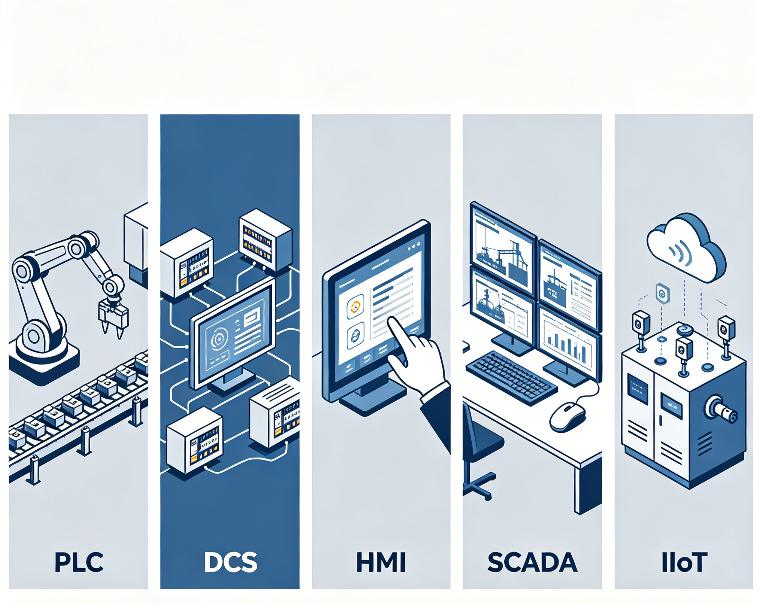
In modern industrial environments, reliable communication networks have become the foundation of efficient production, intelligent manufacturing, and advanced automation. From manufacturing plants and process industries to energy facilities and transportation systems, industrial network switches play a critical role in ensuring stable data transmission between PLCs, HMIs, sensors, remote I/O modules, industrial computers, and control systems.
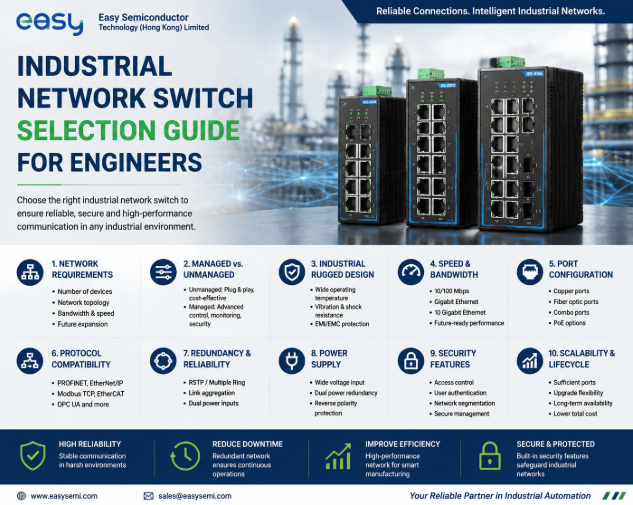
Unlike commercial Ethernet switches designed for office environments, industrial network switches are engineered to operate under demanding conditions, including extreme temperatures, electrical interference, vibration, dust, and continuous 24/7 operation. Selecting the right industrial network switch requires engineers to carefully evaluate network requirements, environmental conditions, communication protocols, and future expansion needs.
Easy Semiconductor Technology (Hong Kong) Limited provides industrial automation components and solutions to support global engineers, system integrators, and industrial customers in building reliable and efficient control networks.
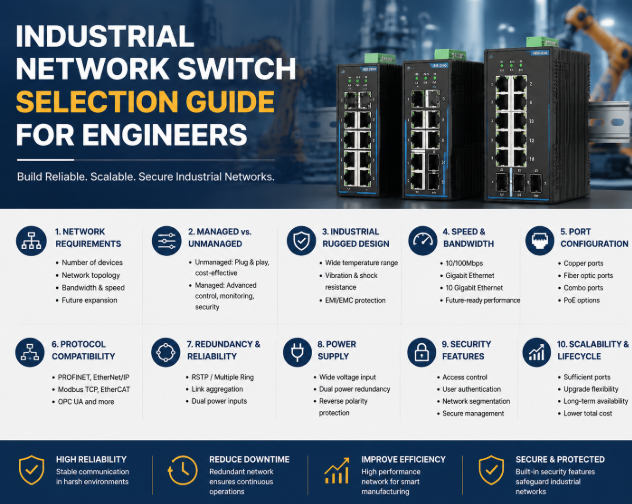
An industrial network switch is a key communication device that connects multiple Ethernet-enabled industrial devices within an automation system. It manages data traffic efficiently and ensures that critical information reaches the correct destination with minimal delay.
In industrial applications, network switches are commonly used for:
Factory automation networks
Process control systems
Power and energy management systems
Oil and gas facilities
Water treatment plants
Transportation infrastructure
Building automation systems
Industrial IoT (IIoT) platforms
As factories become more connected, the demand for high-performance industrial Ethernet infrastructure continues to grow. A properly selected network switch improves system availability, reduces downtime, and supports long-term operational stability.
Before selecting a switch, engineers should analyze the overall network architecture and communication requirements.
Important considerations include:
Number of connected devices
Required Ethernet speed
Network topology
Data traffic volume
Communication protocols
Redundancy requirements
Future expansion plans
For small automation systems, an unmanaged industrial switch may provide sufficient performance. However, large-scale production facilities often require managed switches with advanced monitoring, configuration, and network management capabilities.
One of the most important decisions is choosing between managed and unmanaged switches.
Unmanaged switches provide simple plug-and-play Ethernet connectivity. They are suitable for applications where network configuration and monitoring are not required.
Advantages include:
Easy installation
Lower cost
Simple operation
Reliable basic communication
Typical applications include small machine systems, standalone equipment, and simple automation networks.
Managed switches provide advanced network control and monitoring features.
Common functions include:
VLAN configuration
Network diagnostics
Port monitoring
Traffic management
Remote configuration
Security features
Redundant network support
Managed switches are preferred for large industrial systems where communication reliability and troubleshooting capability are essential.
Industrial environments are significantly more challenging than office environments. Engineers must select switches that can withstand harsh operating conditions.
Important environmental factors include:
Industrial switches often need to operate in extreme temperatures. Standard commercial switches may fail when exposed to high heat or cold environments.
Engineers should check:
Operating temperature range
Storage temperature range
Thermal design
Installation location
Equipment installed near motors, production lines, or heavy machinery may experience continuous vibration. Industrial switches should have rugged mechanical designs to maintain stable operation.
Factories often contain motors, variable frequency drives, and power equipment that generate electromagnetic interference (EMI). Industrial-grade switches include improved protection against electrical noise.
Industrial applications increasingly require higher bandwidth due to:
High-resolution machine vision systems
Real-time monitoring
Industrial data collection
Remote diagnostics
Cloud connectivity
Common Ethernet speeds include:
10/100 Mbps
Gigabit Ethernet
10 Gigabit Ethernet
Engineers should select a switch that meets current requirements while allowing future upgrades.
Gigabit industrial switches are becoming increasingly common because they provide additional bandwidth for modern smart factories and IIoT applications.
Industrial network switches are available with different port combinations.
Common options include:
Copper Ethernet ports
Fiber optic ports
Combination copper/fiber ports
PoE (Power over Ethernet) ports
The correct configuration depends on network distance and installation requirements.
Copper Ethernet ports are commonly used for short-distance industrial connections.
Advantages:
Cost-effective
Easy installation
Widely compatible
Fiber optic connections are ideal for long-distance communication and environments with high electromagnetic interference.
Benefits include:
Longer transmission distance
Better EMI resistance
Improved network reliability
Modern automation systems use various industrial Ethernet protocols. Engineers should ensure that selected switches are compatible with required communication standards.
Common protocols include:
PROFINET
EtherNet/IP
Modbus TCP
EtherCAT
OPC UA-based industrial networks
Protocol compatibility helps maintain efficient communication between controllers, field devices, and supervisory systems.
Production downtime can result in significant financial losses. For critical applications, network redundancy is essential.
Industrial managed switches may support technologies such as:
Rapid Spanning Tree Protocol (RSTP)
Multiple Ring Protection
Link Aggregation
Dual Power Inputs
Redundant network designs allow communication to continue even if one connection fails.
This is especially important for:
Power plants
Chemical facilities
Continuous production lines
Transportation systems
Industrial switches require reliable power solutions. Engineers should consider:
Input voltage range
Dual power supply capability
Reverse polarity protection
Power failure alarms
Many industrial switches support wide voltage inputs, making them suitable for different industrial environments.
For mission-critical systems, dual power inputs provide additional protection against unexpected power interruptions.
With increasing industrial connectivity, cybersecurity has become a major concern.
Modern industrial managed switches may include:
Access control
User authentication
Secure management protocols
Network segmentation
Port security
Network security helps protect industrial systems from unauthorized access and communication failures.
Industrial systems often operate for many years. Engineers should consider future requirements before selecting network equipment.
A suitable industrial switch should provide:
Additional available ports
Higher bandwidth capacity
Flexible configuration options
Long-term product availability
Selecting scalable equipment reduces future upgrade costs and simplifies system maintenance.
Selecting the correct industrial network switch is not only about technical specifications. Engineers should also consider supplier reliability, product quality, technical support, and long-term availability.
Easy Semiconductor Technology (Hong Kong) Limited focuses on providing industrial automation products and solutions for global customers. With experience in industrial control components, the company supports engineers and system integrators in selecting suitable products for different automation applications.
Reliable industrial networking solutions help companies improve production efficiency, reduce maintenance costs, and achieve higher levels of automation performance.
Industrial network switches are essential components of modern automation infrastructure. Choosing the right switch requires careful evaluation of network requirements, environmental conditions, communication protocols, reliability features, and future expansion needs.
For engineers designing industrial control systems, investing in high-quality industrial Ethernet solutions ensures stable communication, improved operational efficiency, and long-term system reliability.
As manufacturing continues to move toward smart factories and Industrial IoT, reliable network infrastructure will remain a critical factor in achieving successful digital transformation.
Easy Semiconductor Technology (Hong Kong) Limited is committed to supporting industrial customers with reliable automation components and professional solutions for modern industrial applications.