
 home
home
 Published: Aug 08, 2026 01:06 PM
 Page View: 159
In modern industrial environments, accurate flow measurement plays a critical role in improving production efficiency, ensuring process safety, and optimizing resource management. From chemical plants and oil refineries to water treatment facilities, power generation systems, and smart factories, industrial flow meters provide essential data for monitoring and controlling liquid, gas, and steam processes.
Choosing the right flow meter is a complex engineering decision. Different applications require different measurement technologies, installation methods, accuracy levels, and operating conditions. A poorly selected flow meter can lead to inaccurate data, increased maintenance costs, energy waste, and even production interruptions.
Easy Semiconductor Technology (Hong Kong) Limited provides professional industrial automation solutions and supports global customers in selecting reliable measurement technologies for demanding industrial applications. This guide explains the key factors engineers should consider when selecting industrial flow meters.
Flow measurement is one of the most important parameters in industrial automation systems. Accurate flow data enables engineers to:
Control production processes more efficiently
Reduce material waste and operating costs
Improve energy management
Detect abnormal operating conditions early
Maintain product quality and consistency
Support digital transformation and industrial IoT applications
In automated plants, flow meters are often integrated with PLC systems, distributed control systems (DCS), SCADA platforms, and industrial networks to provide real-time monitoring and control.
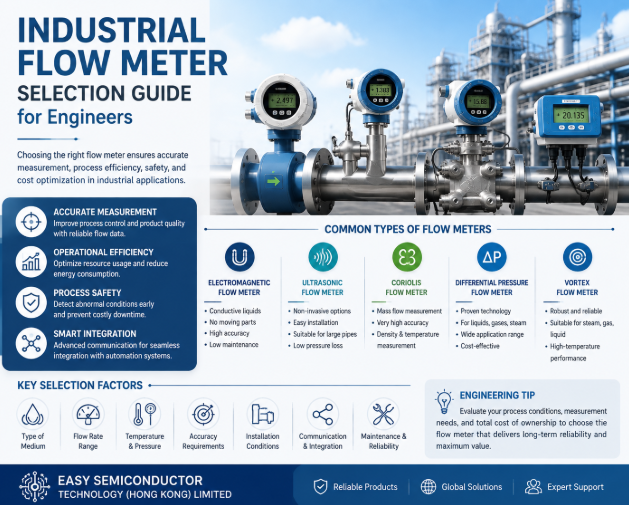
Engineers must first understand the different flow measurement technologies available. Each type has advantages and limitations depending on the application.
Electromagnetic flow meters are widely used for measuring conductive liquids such as water, wastewater, chemicals, and slurry.
Advantages include:
No moving parts, resulting in low maintenance requirements
High accuracy and stable performance
Suitable for corrosive and contaminated fluids
Minimal pressure loss
However, electromagnetic flow meters cannot measure non-conductive liquids such as oil or gas.
Ultrasonic flow meters use sound waves to measure flow velocity and are suitable for both liquid and gas applications.
Key benefits:
Non-invasive measurement options available
Easy installation without cutting pipelines
Suitable for large diameter pipes
Low maintenance requirements
They are commonly used in water distribution, energy management, and industrial utility monitoring.
Coriolis flow meters are known for extremely high accuracy and the ability to measure mass flow directly.
Advantages:
Direct mass flow measurement
High accuracy for critical processes
Can measure density and temperature simultaneously
Suitable for advanced process control
They are commonly applied in pharmaceutical, food processing, chemical, and petroleum industries where measurement precision is essential.
Differential pressure (DP) flow meters measure flow by detecting pressure differences across a restriction device such as an orifice plate, venturi tube, or nozzle.
Benefits:
Proven technology with decades of industrial use
Suitable for liquids, gases, and steam
Compatible with many industrial systems
However, they may cause permanent pressure loss and require proper calibration.
Vortex flow meters are frequently used for steam, gas, and liquid measurement.
Advantages:
Reliable design with fewer moving components
Suitable for high-temperature applications
Good performance in industrial utility systems
They are often installed in power plants, heating systems, and process industries.
Selecting the correct flow meter requires careful evaluation of operating conditions and process requirements.
The first consideration is the material being measured:
Water and wastewater
Chemicals
Oil and fuel
Steam
Compressed air
Natural gas
Food and pharmaceutical fluids
Different fluids have different properties, including conductivity, viscosity, density, temperature, and corrosiveness.
Engineers should evaluate both minimum and maximum flow conditions.
A flow meter must provide accurate measurement throughout the expected operating range. Selecting a meter with an unsuitable range may result in poor accuracy or unstable readings.
Industrial environments often involve extreme temperatures and high pressures.
Before selection, engineers should confirm:
Maximum operating temperature
Maximum pressure rating
Material compatibility
Environmental protection level
For harsh environments, robust industrial-grade designs are recommended.
Different applications require different accuracy levels.
For example:
Utility monitoring may require moderate accuracy
Chemical dosing systems require higher precision
Custody transfer applications require extremely high accuracy
Understanding the required measurement performance helps avoid unnecessary costs while ensuring reliability.
Installation factors significantly affect flow meter performance.
Engineers should consider:
Pipe diameter
Straight pipe length requirements
Installation direction
Available space
Accessibility for maintenance
Proper installation improves measurement stability and extends equipment lifetime.
With the development of Industry 4.0, modern flow meters are becoming intelligent measurement devices capable of advanced communication and diagnostics.
Smart flow meters can provide:
Real-time process data
Remote configuration
Predictive maintenance information
Self-diagnosis functions
Integration with industrial communication networks
Common communication protocols include:
HART
Modbus
PROFIBUS
FOUNDATION Fieldbus
Industrial Ethernet solutions
These technologies help factories improve operational visibility and achieve smarter production management.
Industrial flow meters are widely used across multiple industries.
Chemical plants require accurate measurement of aggressive and hazardous fluids. Coriolis and electromagnetic flow meters are often selected for precise process control.
Water facilities depend on reliable flow measurement for water distribution, filtration processes, and wastewater management.
Oil and gas applications require high-performance meters capable of handling high pressure, extreme temperatures, and strict accuracy requirements.
Flow meters are essential for monitoring steam, cooling water, fuel, and other utility systems.
Factories use flow meters to monitor compressed air, cooling systems, and production materials to improve efficiency.
A good flow meter selection should consider the entire lifecycle of the equipment.
Important factors include:
Calibration requirements
Spare parts availability
Environmental durability
Manufacturer support
Total cost of ownership
Reliable measurement equipment reduces unexpected downtime and improves overall plant performance.
Selecting the right industrial flow meter requires a comprehensive understanding of process conditions, measurement requirements, and system integration needs. Engineers must evaluate fluid characteristics, flow range, temperature, pressure, accuracy, installation environment, and communication capabilities before making a decision.
As industrial automation continues to evolve, intelligent flow measurement solutions will become increasingly important for improving efficiency, safety, and digital transformation.
Easy Semiconductor Technology (Hong Kong) Limited is committed to providing reliable industrial automation products and technical solutions for global customers. By helping engineers choose suitable measurement technologies, the company supports smarter, safer, and more efficient industrial operations worldwide.