
 home
home
 Published: Aug 19, 2026 09:10 PM
 Page View: 143
Industrial control cabinets are essential components in modern automation systems, providing a secure and organized environment for electrical devices, control equipment, and communication components. From manufacturing plants and process industries to energy systems and smart factories, well-designed control cabinets help ensure reliable operation, easier maintenance, and improved safety.
For beginners entering the field of industrial automation, designing a control cabinet may seem complex due to the variety of components, wiring requirements, and industry standards involved. However, by understanding the fundamental principles of cabinet design, engineers and technicians can create efficient, safe, and scalable solutions.
Easy Semiconductor Technology (Hong Kong) Limited provides industrial automation components and electronic solutions to support customers in building reliable control systems. This guide introduces the key considerations for designing industrial control cabinets and explains the basic steps for beginners.
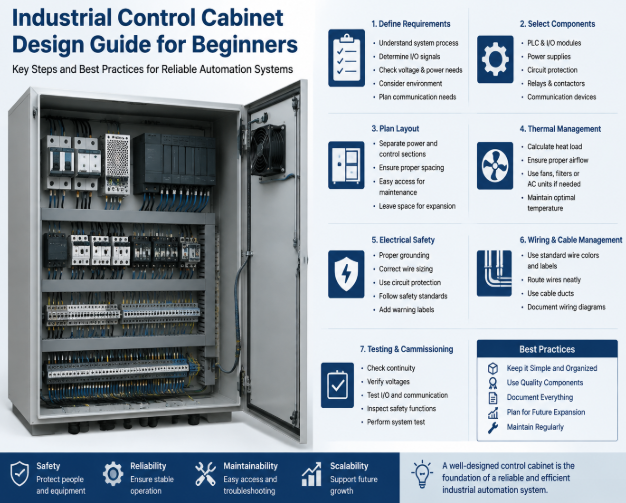
An industrial control cabinet is designed to house and protect electrical and automation equipment used to monitor and control industrial processes. A typical cabinet may include programmable logic controllers (PLCs), power supplies, circuit breakers, relays, terminal blocks, communication modules, motor control devices, and safety components.
The main functions of a control cabinet include:
Protecting electrical equipment from dust, moisture, and physical damage.
Providing centralized control and monitoring of industrial systems.
Improving system organization through structured wiring and component arrangement.
Ensuring operator and maintenance personnel safety.
Supporting future expansion and system upgrades.
A good cabinet design balances functionality, safety, accessibility, and cost efficiency.
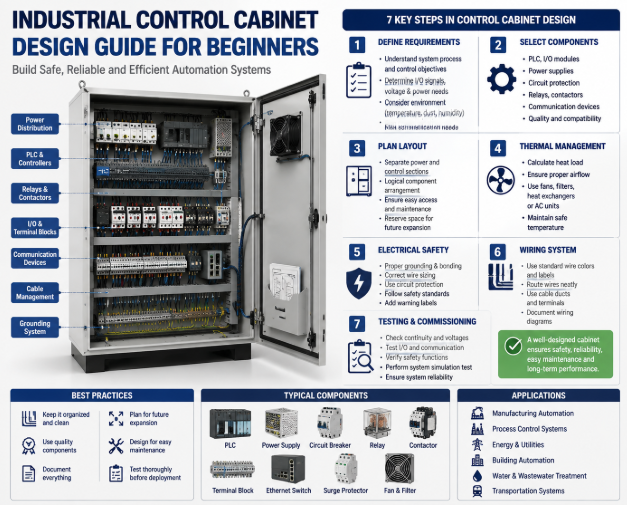
Before selecting components or designing layouts, engineers should clearly understand the application requirements. Important questions include:
What industrial process will the cabinet control?
How many input and output signals are required?
What voltage levels and power ratings are involved?
Are there environmental challenges such as heat, vibration, or humidity?
Are communication networks required?
For example, a food processing facility may require stainless steel cabinets with higher protection ratings, while a factory automation line may focus more on high-speed communication and motor control capabilities.
A detailed requirement analysis helps prevent redesign problems and ensures that the final cabinet meets operational needs.
Choosing reliable components is one of the most important parts of cabinet design. Common industrial control cabinet components include:
PLCs act as the central control unit of many automation systems. They receive signals from sensors, process programmed logic, and send commands to machines and devices.
Industrial power supplies convert incoming electrical power into stable DC voltage for control devices. Selecting a power supply with sufficient capacity and reliability is essential for system stability.
Circuit breakers, fuses, and surge protection devices help protect equipment from electrical faults and unexpected damage.
Relays and contactors allow control systems to switch higher-power loads safely while isolating sensitive electronic circuits.
Modern industrial systems often require Ethernet switches, communication modules, and industrial networking devices to connect machines, controllers, and supervisory systems.
When selecting components, engineers should consider compatibility, lifecycle availability, operating conditions, and manufacturer support.
A well-organized cabinet layout improves reliability and simplifies maintenance. Components should be arranged logically according to their functions.
A common layout approach includes:
Power Section:
High-voltage components such as incoming power terminals, circuit breakers, and contactors are placed separately from sensitive control equipment.
Control Section:
PLCs, I/O modules, relays, and communication devices are installed in an organized area for easy access.
Wiring Section:
Terminal blocks and cable management systems provide structured connections between field devices and internal components.
Good layout practices include:
Keeping power and signal wiring separated.
Providing enough space for heat dissipation.
Leaving extra room for future expansion.
Placing frequently serviced components in accessible locations.
Using clear labels for all devices and wires.
Heat management is a critical factor in industrial cabinet design. Excessive temperature can reduce equipment lifespan and cause unexpected failures.
Engineers should calculate heat generation from components such as:
PLC modules.
Power supplies.
Drives and motor controllers.
Communication devices.
Transformers.
Cooling solutions may include ventilation fans, filters, heat exchangers, or air conditioning units depending on the environment.
Proper spacing between components also improves airflow and reduces thermal stress.
Safety should always be a priority when designing industrial control cabinets. A professional cabinet design should follow applicable electrical standards and best practices.
Important safety considerations include:
Proper grounding and bonding.
Correct wire sizing and insulation selection.
Appropriate circuit protection.
Emergency stop integration where required.
Clear warning labels and identification markings.
Safe separation between high-voltage and low-voltage circuits.
Following safety standards reduces risks and improves long-term system reliability.
Wiring quality directly affects cabinet performance. Poor wiring practices can create troubleshooting difficulties and increase downtime.
Recommended wiring practices include:
Use standardized wire colors and labels.
Keep wiring neat with cable ducts and routing channels.
Avoid unnecessary cable loops.
Use proper terminals and connectors.
Document wiring diagrams for future maintenance.
A clean wiring design allows technicians to quickly identify problems and perform repairs efficiently.
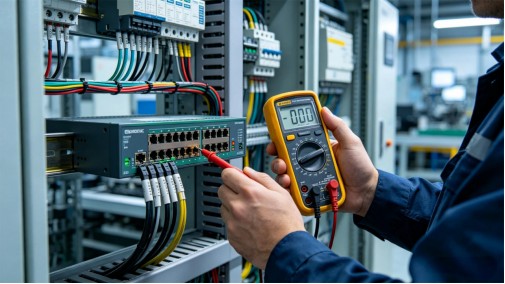
Before installation in an industrial environment, every control cabinet should undergo testing.
Typical testing procedures include:
Checking electrical continuity.
Verifying voltage levels.
Testing communication connections.
Confirming PLC input and output operation.
Inspecting safety functions.
Performing system simulation tests.
Detailed testing helps identify design errors before the cabinet is connected to production equipment.
New designers often encounter several common challenges:
Overcrowding components may cause overheating and make maintenance difficult. Always reserve additional space for future modifications.
A cabinet designed for a clean indoor environment may fail in areas with dust, moisture, or extreme temperatures.
Missing electrical drawings and component information can increase maintenance time and operational costs.
Using components without considering load requirements, compatibility, or industrial ratings can reduce system reliability.
With the growth of Industry 4.0, industrial control cabinets are becoming smarter and more connected. Modern designs increasingly integrate:
Industrial Ethernet communication.
Remote monitoring systems.
Edge computing devices.
Energy management solutions.
Predictive maintenance technologies.
Future control cabinets will not only control machines but also provide valuable production data to improve efficiency and decision-making.
Designing an industrial control cabinet requires careful planning, component selection, electrical knowledge, and attention to safety. For beginners, understanding basic design principles is the first step toward creating reliable automation systems.
By focusing on system requirements, organized layouts, proper thermal management, safe wiring practices, and thorough testing, engineers can develop control cabinets that deliver long-term performance.
Easy Semiconductor Technology (Hong Kong) Limited is committed to providing high-quality semiconductor products and industrial automation solutions to support customers in building efficient and dependable control systems. With the right components and professional design practices, industrial control cabinets can become the foundation of modern automated operations.