
 home
home
 Published: Jul 30, 2026 09:21 AM
 Page View: 172
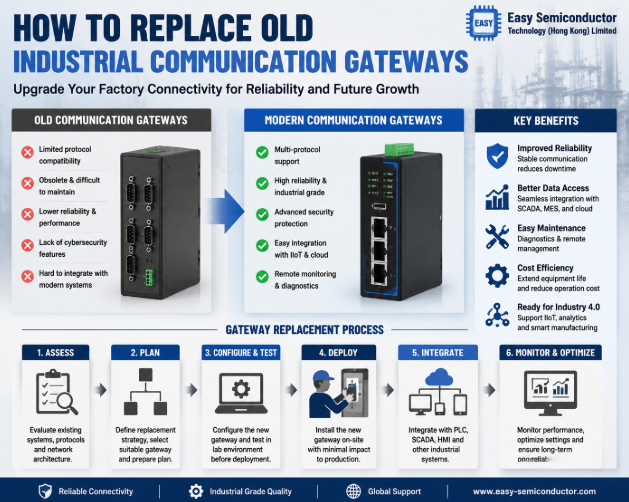
In today’s rapidly evolving industrial environment, reliable communication between automation systems, field devices, and enterprise networks has become essential for maintaining efficient production operations. However, many factories and process facilities still rely on aging industrial communication gateways that were installed decades ago. These legacy gateways may face problems such as discontinued support, limited protocol compatibility, communication failures, and difficulty integrating with modern industrial networks.
Easy Semiconductor Technology (Hong Kong) Limited provides professional industrial automation solutions to help manufacturers replace outdated communication gateways with modern, reliable alternatives. Through careful evaluation, migration planning, and technical support, companies can upgrade their industrial communication infrastructure while minimizing production downtime and operational risks.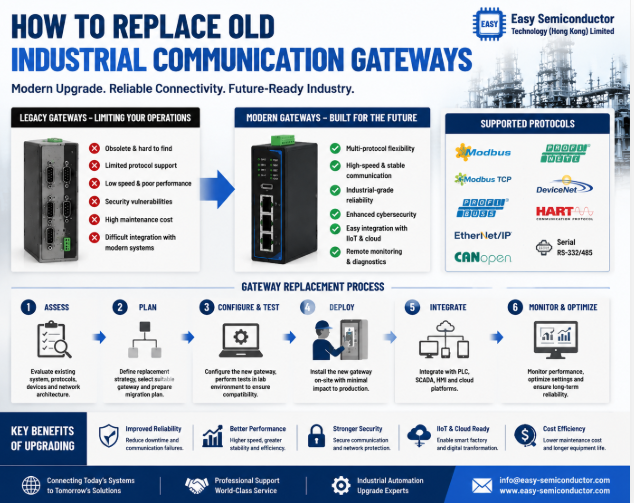
Industrial communication gateways serve as critical bridges between different automation systems, allowing PLCs, DCS platforms, remote I/O modules, sensors, and supervisory systems to exchange data. Many older gateways were designed for specific communication standards and may no longer meet current industrial requirements.
Common problems with outdated gateways include:
Obsolete communication protocols: Older systems may rely on legacy protocols that are difficult to connect with modern Ethernet-based networks.
Limited manufacturer support: Original manufacturers may discontinue product lines, making spare parts and technical assistance difficult to obtain.
Reduced reliability: Aging electronic components can cause intermittent communication failures, unexpected downtime, and data transmission errors.
Cybersecurity limitations: Older gateways often lack modern security features required for industrial network protection.
Integration difficulties: Legacy gateways may not support cloud platforms, industrial IoT applications, or advanced monitoring systems.
Replacing these devices is becoming a necessary step for companies seeking improved productivity, higher availability, and long-term system sustainability.
A successful gateway replacement project begins with a detailed assessment of the existing automation environment. Engineers should analyze the current communication architecture, connected devices, and operational requirements.
Key evaluation points include:
The first step is understanding the communication protocols currently in use. Industrial facilities may utilize:
Modbus RTU
Modbus TCP
PROFIBUS
PROFINET
Ethernet/IP
CAN bus
DeviceNet
HART communication
Serial RS-232/RS-485 networks
Selecting a replacement gateway requires compatibility with both legacy field devices and modern control systems.
Engineers should document how the existing gateway connects with:
PLC controllers
Distributed Control Systems (DCS)
SCADA platforms
Human Machine Interfaces (HMI)
Remote monitoring systems
Industrial Ethernet networks
This helps determine whether a direct replacement or a complete communication upgrade is more suitable.
A replacement gateway should not only solve current problems but also support future automation upgrades. Companies should consider:
Additional device connections
Higher communication speed
Remote diagnostics
Industrial IoT integration
Data collection and analytics requirements
Choosing a suitable industrial communication gateway requires balancing compatibility, performance, reliability, and cost.
Important selection criteria include:
Modern gateways should support multiple industrial protocols, allowing seamless communication between old and new equipment. Multi-protocol capability reduces the need for additional hardware and simplifies future system upgrades.
Industrial environments often involve vibration, temperature fluctuations, electrical noise, and continuous operation. Replacement gateways should provide:
Industrial-grade components
Stable long-term operation
Wide temperature tolerance
Strong electromagnetic interference resistance
Modern communication gateways should offer user-friendly configuration software, diagnostic tools, and remote monitoring capabilities. These features help reduce troubleshooting time and improve maintenance efficiency.
As factories become more connected, cybersecurity becomes increasingly important. New gateway solutions should support:
Secure communication methods
Access control
Network segmentation
Data protection mechanisms
Different industrial environments require different replacement approaches. The following migration strategies are commonly used:
For systems with stable architecture, the existing gateway can be replaced with a modern equivalent supporting the same communication protocols.
Advantages:
Short installation time
Lower engineering cost
Minimal system modification
This approach is suitable when the existing control system remains operational and only communication hardware requires upgrading.
In some cases, companies need to connect legacy equipment with modern industrial networks. A protocol conversion gateway can translate communication between different systems.
For example:
PROFIBUS devices connected to Ethernet networks
Modbus RTU equipment integrated into cloud monitoring systems
Serial devices connected with modern PLC platforms
This allows manufacturers to extend the service life of existing equipment without replacing entire automation systems.
For large-scale industrial facilities, replacing multiple outdated gateways with a standardized communication architecture may provide better long-term benefits.
A modernization project may include:
New industrial Ethernet infrastructure
Updated communication gateways
Network switches
Remote monitoring solutions
Data acquisition platforms
Although the initial investment may be higher, this approach improves scalability and future maintenance efficiency.
Production downtime is one of the biggest concerns during industrial upgrades. Proper planning can significantly reduce operational interruptions.
Recommended practices include:
Before installation, engineers should prepare:
Existing system documentation
Communication parameter backups
Network configuration records
Device address mapping
Testing procedures
Whenever possible, replacement gateways should be configured and tested before installation at the production site. This reduces commissioning time and prevents unexpected issues.
For critical production systems, a phased replacement strategy is often preferred. Individual sections of the communication network can be upgraded while keeping the rest of the system operational.
Replacing outdated communication gateways delivers multiple advantages:
New gateways reduce communication interruptions and improve data transmission stability, helping factories maintain continuous production.
Modern gateways enable easier integration with SCADA systems, industrial databases, and digital transformation platforms.
Advanced diagnostics allow engineers to identify communication problems quickly and reduce troubleshooting time.
Instead of replacing complete automation systems, upgrading communication infrastructure can extend the useful life of existing industrial equipment.
Modern communication gateways provide the foundation for Industrial IoT, predictive maintenance, and intelligent manufacturing applications.
Easy Semiconductor Technology (Hong Kong) Limited specializes in providing industrial automation components, replacement solutions, and technical support for companies operating legacy control systems. With experience in industrial communication products, automation modules, and obsolete equipment replacement, the company helps customers improve system reliability while reducing upgrade risks.
From identifying suitable gateway replacements to supporting industrial modernization projects, Easy Semiconductor Technology (Hong Kong) Limited focuses on delivering practical solutions for factories, power facilities, process industries, and manufacturing companies worldwide.
Replacing old industrial communication gateways is a key step toward improving automation reliability and preparing factories for future digital transformation. By carefully evaluating existing systems, selecting compatible replacement solutions, and implementing a structured migration plan, companies can upgrade their communication infrastructure without unnecessary production disruption.
With professional support and modern industrial communication technologies, aging automation systems can continue delivering value while meeting the requirements of today’s connected manufacturing environment.