
 home
home
 Published: Aug 08, 2026 12:55 PM
 Page View: 150
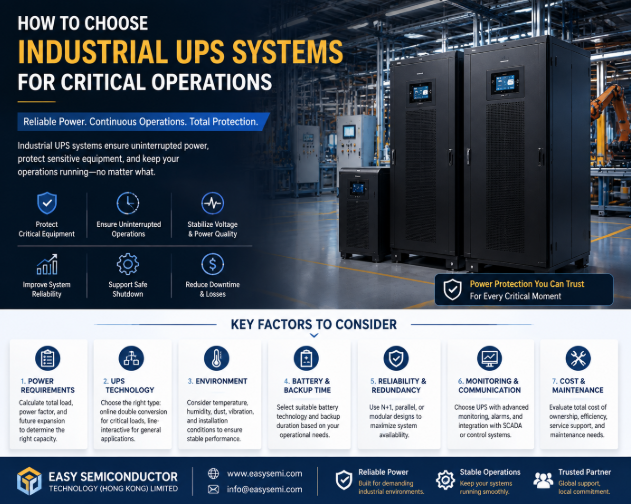
In today’s highly automated industrial environment, uninterrupted power supply has become a fundamental requirement for maintaining safe, efficient, and continuous operations. From manufacturing plants and process industries to data centers, energy facilities, and transportation systems, even a short power interruption can result in production losses, equipment damage, safety risks, and costly downtime.
Industrial Uninterruptible Power Supply (UPS) systems are designed to provide reliable backup power and protect critical equipment from voltage fluctuations, power failures, and electrical disturbances. However, selecting the right industrial UPS system requires careful evaluation of operational requirements, load characteristics, environmental conditions, and future expansion plans.
Easy Semiconductor Technology (Hong Kong) Limited provides professional industrial automation solutions and supports global customers in selecting reliable power management products for demanding industrial applications.
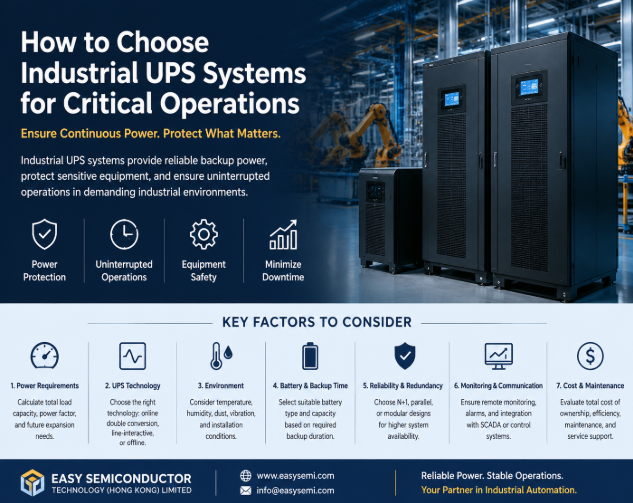
Unlike standard commercial UPS products, industrial UPS systems are engineered for harsh environments and mission-critical applications. They are designed to operate continuously under challenging conditions, including extreme temperatures, electrical noise, vibration, dust, and unstable grid power.
An industrial UPS system performs several key functions:
Provides backup power during utility failures
Stabilizes voltage and frequency fluctuations
Protects sensitive automation equipment
Prevents sudden shutdowns of critical processes
Supports safe equipment shutdown procedures
Improves overall system reliability
For industries such as chemical processing, oil and gas, semiconductor manufacturing, pharmaceutical production, and infrastructure management, reliable power protection is essential for maintaining operational safety and productivity.
The first step in selecting an industrial UPS system is understanding the electrical requirements of the connected equipment.
Engineers should analyze:
Total connected load power
Required UPS capacity
Starting current requirements
Power factor characteristics
Future load expansion possibilities
UPS capacity is typically measured in kVA or kW. Selecting a UPS with insufficient capacity may lead to overload conditions, while choosing an oversized system may increase unnecessary investment costs.
A proper design should include additional capacity margins to accommodate future equipment additions and unexpected load increases. Many industrial facilities choose UPS systems with 20% to 30% additional capacity for long-term reliability.
Industrial UPS systems are available in different designs, each suitable for specific applications.
Online double conversion UPS systems are widely used in critical industrial operations. They continuously convert incoming AC power to DC and then regenerate clean AC output power.
Advantages include:
Zero transfer time during power failure
Excellent voltage regulation
Protection against electrical disturbances
Stable output power quality
This type is ideal for sensitive automation systems, industrial control equipment, communication networks, and process control applications.
Line-interactive UPS systems provide voltage regulation and battery backup protection. They are suitable for less critical applications where short power interruptions are acceptable.
Offline UPS systems are mainly used for basic backup requirements. They are generally not recommended for high-risk industrial environments where continuous operation is required.
For critical industrial operations, online double conversion technology is often the preferred choice due to its superior protection performance.
Industrial environments can be significantly different from office or commercial locations. UPS systems installed in factories and plants must withstand demanding conditions.
Important environmental factors include:
Operating temperature range
Humidity levels
Dust and chemical exposure
Vibration and mechanical stress
Installation location
For harsh industrial environments, engineers should select UPS systems with robust enclosure designs, high protection ratings, and industrial-grade components.
Proper ventilation and cooling systems should also be considered to ensure long service life and stable performance.
The battery system is one of the most important components of an industrial UPS solution.
Key considerations include:
Required backup duration
Battery technology
Maintenance requirements
Replacement cycle
Operating temperature
Common industrial UPS battery options include:
Valve-Regulated Lead Acid (VRLA) batteries
Lithium-ion batteries
Nickel-Cadmium batteries
Lithium-ion batteries are becoming increasingly popular due to their longer lifespan, higher energy density, and lower maintenance requirements. However, traditional battery technologies remain widely used because of their reliability and cost advantages.
The required backup time depends on the application. Some systems only require several minutes to allow safe shutdown, while others require extended backup power until standby generators become available.
For critical operations, reliability is a primary selection factor. Industrial facilities often implement redundant UPS configurations to reduce the risk of system failure.
Common redundancy designs include:
An N+1 UPS system includes one additional UPS module beyond the required capacity. If one module fails, the remaining modules continue supporting the load.
Multiple UPS units operate together to increase capacity and improve system availability.
Modular UPS systems allow users to add power modules as demand increases, providing flexibility and easier maintenance.
Redundant designs are especially important for industries where downtime can result in significant financial losses or safety concerns.
Modern industrial UPS systems include advanced monitoring capabilities that allow operators to track system status in real time.
Important features include:
Remote monitoring
Battery health monitoring
Alarm notifications
Network communication interfaces
Integration with SCADA and industrial control systems
Integration with existing automation platforms enables predictive maintenance and helps engineers identify potential issues before failures occur.
When selecting an industrial UPS, purchase price should not be the only consideration. The total cost of ownership includes:
Initial investment
Energy efficiency
Battery replacement costs
Maintenance requirements
Spare parts availability
Service support
A high-efficiency UPS system can significantly reduce energy consumption and operating expenses over its lifetime.
Reliable technical support and availability of replacement components are also important factors for long-term operation.
Industrial UPS systems are widely used in various sectors, including:
UPS systems protect PLCs, HMIs, industrial computers, and automation networks from power interruptions.
Power plants and substations rely on UPS systems to maintain control systems, protection equipment, and communication networks.
UPS solutions support safety systems, monitoring equipment, and critical process controls in remote and hazardous environments.
Precision production requires stable power quality to prevent equipment damage and production defects.
Railways, airports, and traffic management systems depend on reliable backup power for continuous operation.
Choosing the right industrial UPS system is a critical decision that directly affects operational safety, equipment protection, and business continuity. Engineers must consider power capacity, UPS technology, environmental conditions, battery performance, redundancy requirements, monitoring capabilities, and long-term operating costs.
With increasing industrial automation and digital transformation, reliable power protection has become more important than ever. A properly selected UPS system ensures that critical operations remain stable even during unexpected power events.
Easy Semiconductor Technology (Hong Kong) Limited is committed to providing reliable industrial automation and electronic solutions for customers worldwide. Through professional product selection support and technical expertise, the company helps industries improve power reliability, enhance system efficiency, and achieve safer continuous operations.