
 home
home
 Published: Aug 17, 2026 06:50 PM
 Page View: 146
In modern industrial automation systems, control cabinets serve as the central hub for managing electrical equipment, machinery, and production processes. Among the many components installed inside these cabinets, industrial relays play a critical role in ensuring reliable switching, signal isolation, and safe operation. Selecting the right industrial relay is essential for improving system performance, reducing downtime, and extending equipment service life.
With the rapid development of smart factories, automated production lines, and industrial IoT applications, control cabinets are becoming increasingly complex. Engineers must carefully evaluate relay specifications, environmental conditions, electrical requirements, and application demands before making a selection. Easy Semiconductor Technology (Hong Kong) Limited provides professional industrial automation components and solutions to help customers choose reliable relay products for various industrial applications.
An industrial relay is an electrically operated switching device that allows a low-power control signal to operate higher-power electrical circuits. In control cabinets, relays are commonly used to control motors, valves, lighting systems, heaters, sensors, PLC outputs, and other industrial devices.
The main functions of industrial relays include:
Electrical isolation between control and power circuits
Signal amplification for controlling higher loads
Switching automation equipment safely
Protecting sensitive control systems from electrical interference
Improving system flexibility and maintenance efficiency
Compared with standard commercial relays, industrial relays are designed to withstand harsh operating conditions, including vibration, temperature changes, electrical noise, and continuous switching operations.
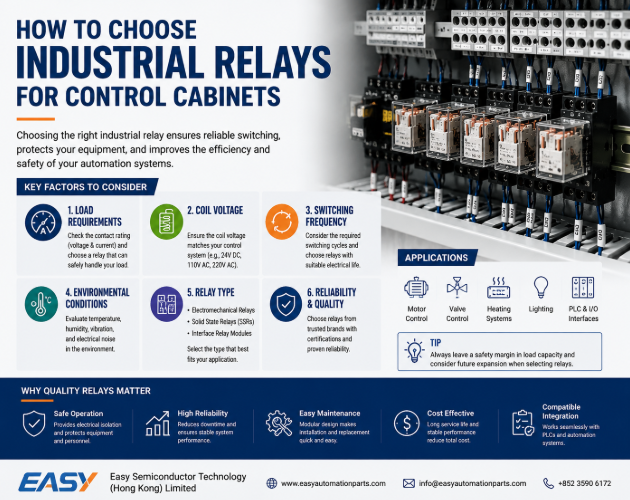
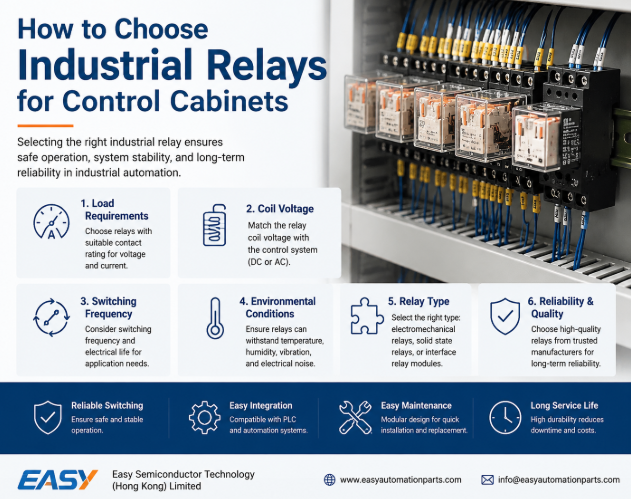
The first step in choosing an industrial relay is understanding the electrical load that needs to be controlled. Different applications require different relay contact ratings and switching capabilities.
Important parameters include:
The contact rating determines how much voltage and current the relay can safely switch. Engineers should select relays with sufficient capacity based on the connected equipment.
For example:
Low-power signals may require only a few amperes
Motors and industrial actuators may require higher current ratings
Heating systems often require relays designed for continuous high-power operation
Choosing a relay with insufficient capacity can result in contact wear, overheating, or premature failure.
Industrial relays are available for both AC and DC applications. The switching characteristics of AC and DC loads are different, especially when dealing with inductive equipment such as motors and solenoid valves.
Selecting a relay designed specifically for the application helps ensure stable operation and reduces electrical stress on relay contacts.
The relay coil voltage must match the control system voltage. Common industrial control voltages include:
24V DC
12V DC
110V AC
220V AC
In many modern automation systems, 24V DC relay coils are widely used because they are compatible with PLC systems and provide improved safety for control circuits.
Engineers should also consider coil power consumption, especially in large control cabinets containing many relay modules. Low-power relay solutions can help reduce heat generation and improve cabinet efficiency.
Industrial environments often require relays to operate thousands or even millions of times during their service life. Therefore, switching frequency and mechanical durability are important selection factors.
For applications with frequent switching cycles, such as packaging machines, assembly lines, and automated processing equipment, users should select relays with:
High mechanical endurance
Long electrical life
Reliable contact materials
Fast response characteristics
For less frequent switching applications, standard industrial relays may provide sufficient performance while maintaining cost efficiency.
Control cabinets are often installed in challenging industrial environments. Temperature, humidity, dust, and vibration can affect relay performance.
When selecting industrial relays, consider:
Relay specifications should match the expected operating temperature inside the cabinet. Industrial-grade relays are typically designed for wider temperature ranges compared with general-purpose products.
Industrial machinery can generate electromagnetic interference (EMI) and voltage spikes. Reliable relays should provide good insulation performance and, where necessary, include protective features such as:
Surge suppression
Noise reduction circuits
Proper isolation between coil and contacts
Modern control cabinets require compact designs with high component density. Slim relay modules and DIN-rail mounted relay interfaces can help save valuable cabinet space while simplifying installation.
Different industrial applications require different relay technologies.
Electromechanical relays are widely used because of their versatility, durability, and ability to handle various loads. They are suitable for general industrial control applications.
Advantages include:
Strong switching capability
Electrical isolation
Compatibility with many industrial systems
Solid state relays use semiconductor technology instead of mechanical contacts. They are ideal for applications requiring fast and frequent switching.
Benefits include:
No mechanical wear
Silent operation
High switching speed
Long operational life
However, SSRs require proper heat management and are often selected for specific applications such as temperature control systems.
Interface relay modules are commonly used between PLC outputs and field devices. They provide signal conversion, protection, and easier maintenance.
These modules are widely applied in:
Factory automation
Process control systems
Building automation
Industrial monitoring systems
A relay should not only meet electrical requirements but also integrate smoothly into the overall cabinet design.
Key considerations include:
DIN-rail mounting compatibility
Terminal connection method
Wiring convenience
Indicator visibility
Maintenance accessibility
Clear labeling and modular designs help technicians quickly identify and replace components during maintenance.
Industrial automation systems often operate continuously, making component reliability a critical factor. Low-quality relays may lead to unexpected downtime, production losses, and increased maintenance costs.
When selecting suppliers, companies should consider:
Product certifications
Manufacturing standards
Technical support availability
Product testing procedures
Long-term supply capability
Working with experienced industrial component suppliers ensures that selected relay products meet both technical and operational requirements.
As industrial automation continues to evolve, reliable electrical components are becoming increasingly important for modern control systems. Easy Semiconductor Technology (Hong Kong) Limited is committed to providing high-quality automation components and professional technical support for global customers.
By carefully evaluating load requirements, coil specifications, switching performance, environmental conditions, and installation needs, engineers can select industrial relays that deliver stable performance and long-term reliability.
Choosing the correct industrial relay is not only a component decision—it is an investment in the safety, efficiency, and productivity of the entire automation system. With the right selection strategy and trusted supply partners, businesses can build more reliable and future-ready control cabinets for industrial applications.