
 home
home
 Published: Aug 06, 2026 10:58 AM
 Page View: 159
As global manufacturing continues to accelerate toward digital transformation, smart factories are becoming a critical direction for improving productivity, efficiency, and operational intelligence. Among the many technologies driving this evolution, the Human Machine Interface (HMI) plays an essential role by connecting operators, machines, and industrial control systems. Selecting the right HMI for smart factory applications is becoming increasingly important as companies seek reliable, flexible, and intelligent automation solutions.
Easy Semiconductor Technology (Hong Kong) Limited recognizes that modern industrial environments require advanced HMI solutions capable of supporting complex production processes, real-time monitoring, and seamless communication with automation equipment. A well-designed HMI not only improves operational visibility but also helps manufacturers optimize performance, reduce downtime, and achieve higher levels of automation.
Traditional manufacturing systems often relied on isolated control panels and manual inspections. However, smart factories require integrated platforms where data from machines, sensors, PLCs, and industrial networks can be collected and analyzed in real time. HMIs serve as the central interaction point between operators and automated systems, transforming complex industrial data into clear and actionable information.
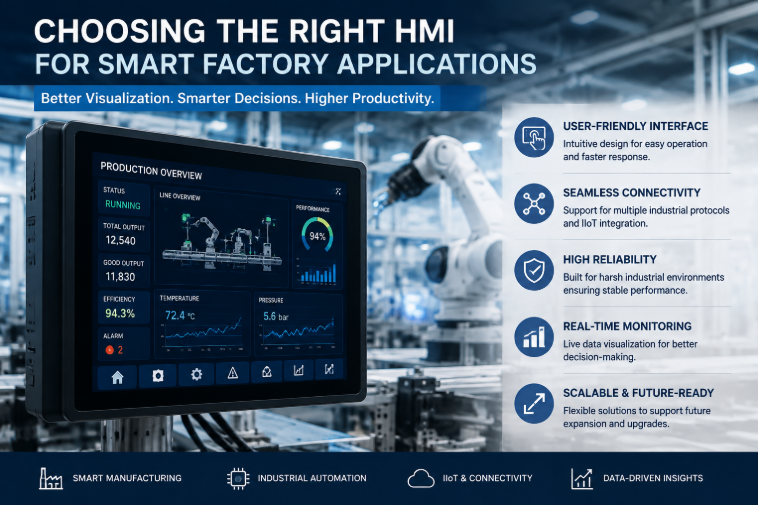
Modern HMIs allow operators to monitor production status, adjust machine parameters, identify equipment issues, and respond quickly to abnormal conditions. By providing intuitive visualization and control functions, HMIs improve decision-making efficiency and reduce the risk of human error.
With the expansion of Industry 4.0, HMIs are evolving beyond simple display devices. Advanced models now support industrial networking, cloud connectivity, remote access, data logging, predictive maintenance, and integration with manufacturing execution systems (MES). These capabilities make HMIs an important component of intelligent factory infrastructure.
Choosing the right HMI requires careful consideration of application requirements, production conditions, and future expansion needs. Several important factors should be evaluated before making a decision.
One of the most important considerations is whether the HMI can communicate effectively with existing automation equipment. Smart factories typically involve multiple devices, including PLCs, industrial computers, sensors, robots, and drives.
A suitable HMI should support common industrial communication protocols such as Ethernet/IP, Modbus TCP, PROFINET, and other field communication standards. Strong compatibility ensures smooth data exchange and allows different systems to operate together efficiently.
For manufacturers upgrading existing facilities, selecting an HMI that supports legacy equipment integration can significantly reduce modernization costs while extending the lifespan of current automation investments.
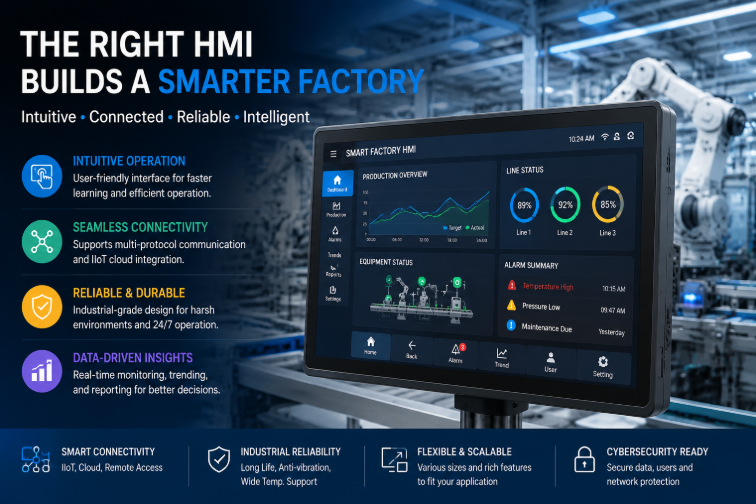
The HMI is the primary interface used by operators, so user experience is a critical factor. A high-quality display should provide clear visualization, fast response, and easy navigation.
Modern industrial HMIs often feature high-resolution touchscreens, customizable graphics, alarm visualization, and multilingual support. These features help operators quickly understand production conditions and respond effectively to operational changes.
An intuitive interface design can reduce training requirements and improve workplace efficiency, especially in industries where operators must manage complex processes under demanding conditions.
Smart factories generate large amounts of operational data from connected machines and sensors. Therefore, HMI performance has become increasingly important.
Advanced HMIs should provide sufficient processing capability to handle real-time monitoring, data storage, graphical visualization, and communication tasks. Faster processors and improved memory capacity enable smoother operation and support advanced industrial applications.
In addition, data management functions such as historical trend analysis, production reports, and event recording help manufacturers identify performance patterns and improve production strategies.
Industrial environments can involve extreme temperatures, dust, vibration, humidity, and electrical interference. Therefore, HMI reliability is essential for maintaining continuous production.
Manufacturers should consider factors such as industrial protection ratings, operating temperature range, screen durability, and long-term stability. A robust HMI designed for industrial use can minimize failures and reduce maintenance requirements.
For industries such as chemical processing, energy production, automotive manufacturing, and semiconductor production, reliable HMI performance is particularly important because unexpected downtime can lead to significant operational losses.
The future of smart manufacturing depends on connectivity. A modern HMI should not only support current requirements but also provide flexibility for future upgrades.
Cloud connectivity, remote monitoring, industrial IoT integration, and cybersecurity features are becoming increasingly important. HMIs with advanced networking capabilities allow factories to build more intelligent and connected production environments.
As manufacturers continue adopting digital solutions, scalable HMI platforms provide a foundation for future automation improvements.
The demand for advanced HMIs is growing across various industrial sectors.
In automotive manufacturing, HMIs enable operators to monitor robotic assembly lines, production cycles, and quality control systems. In semiconductor manufacturing, precise monitoring and control are required to maintain strict process conditions.
In chemical and energy industries, HMIs provide real-time information about critical parameters such as temperature, pressure, and flow rates, helping operators maintain safe and efficient operations.
Food and beverage manufacturers also rely on HMIs to improve production transparency, manage automated equipment, and maintain compliance with quality standards.
Across these industries, the right HMI solution helps companies achieve better productivity, improved safety, and more efficient resource management.
As artificial intelligence, edge computing, and industrial IoT technologies continue to advance, HMI systems will become more intelligent and autonomous. Future HMIs will provide deeper data analysis, enhanced predictive capabilities, and more personalized user experiences.
AI-powered HMIs may assist operators by identifying potential equipment problems before failures occur. Edge-based processing will allow faster decision-making by analyzing production data closer to machines rather than relying entirely on centralized systems.
Cybersecurity will also become a major focus as more industrial devices become connected. Future HMI solutions will require stronger protection mechanisms to safeguard production data and prevent unauthorized access.
As industrial automation continues to evolve, selecting the right HMI has become a strategic decision for manufacturers seeking long-term competitiveness. The ideal HMI should provide reliable performance, strong connectivity, user-friendly operation, and the flexibility required for future smart factory development.
Easy Semiconductor Technology (Hong Kong) Limited remains committed to supporting global customers with advanced industrial automation solutions and semiconductor technologies. By understanding modern manufacturing challenges and technological trends, the company helps businesses improve automation efficiency and move toward smarter, more connected industrial operations.
In the era of Industry 4.0, the right HMI is more than an operator interface—it is a key gateway to intelligent manufacturing, operational excellence, and sustainable industrial growth.