
 home
home
 Published: Aug 15, 2026 02:35 PM
 Page View: 147
In today’s highly competitive industrial environment, system availability and operational continuity have become critical factors for manufacturers, data centers, energy companies, and process industries. Unexpected controller failures can result in production interruptions, financial losses, safety risks, and extended maintenance periods. As automation systems become increasingly complex, selecting the right redundant controller architecture has become an essential step in building reliable and high-performance control systems.
Easy Semiconductor Technology (Hong Kong) Limited understands the importance of reliable automation infrastructure and provides professional solutions for industrial electronic components, automation equipment, and high-availability system requirements. This article explores the key best practices for choosing redundant controllers and how organizations can improve system resilience through effective redundancy planning.
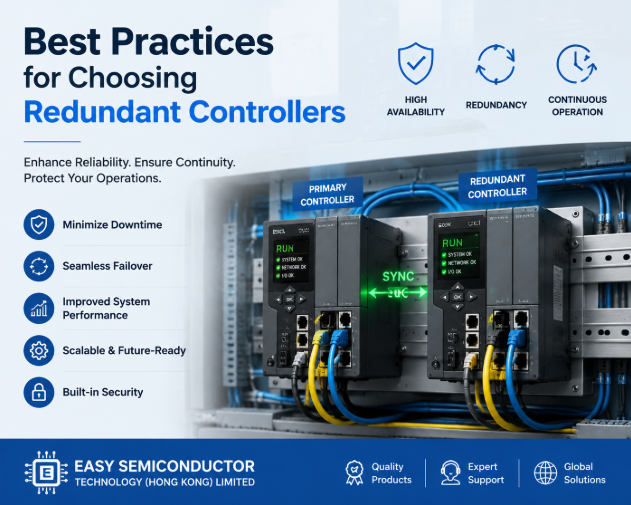
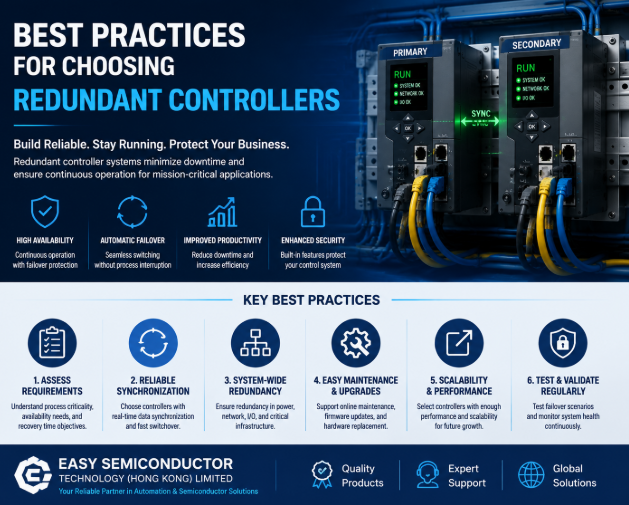
A redundant controller system uses two or more controllers working together to maintain continuous operation. Under normal conditions, the primary controller manages system control tasks, while the secondary controller remains synchronized and ready to take over if the primary unit experiences a failure. This automatic transition, commonly known as failover or switchover, helps reduce downtime and maintain stable operations.
Traditional automation systems often relied on spare controllers stored onsite as backup equipment. However, this approach requires manual replacement, configuration, and recovery time. Modern redundant controller solutions provide active backup capabilities, allowing systems to continue operating even when hardware faults occur.
For industries such as semiconductor manufacturing, power generation, oil and gas, transportation, and large-scale production facilities, controller redundancy is no longer an optional feature—it is a fundamental requirement for maintaining business continuity.
The first step in choosing a redundant controller is understanding the operational requirements of the application. Not every system requires the same level of redundancy. Companies should evaluate:
Required system availability
Acceptable downtime during failures
Process criticality
Safety requirements
Future expansion plans
Maintenance expectations
For mission-critical applications, a hot standby redundant controller configuration is often preferred. In this architecture, the secondary controller continuously synchronizes data with the primary controller and can immediately assume control when a failure occurs. This provides faster recovery compared with warm or cold standby solutions.
Synchronization between primary and secondary controllers is one of the most important factors in a redundant system. A high-quality redundancy solution should provide:
Real-time memory synchronization
Deterministic data transfer
Fast communication between controller pairs
Secure synchronization channels
Minimal impact on system performance
Poor synchronization design can cause inconsistent data states, delayed recovery, or unexpected system behavior during failover events. Industrial automation experts emphasize that deterministic switchover performance is essential for achieving true high availability.
When selecting controllers, engineers should confirm whether synchronization occurs continuously or only when changes are detected. Full synchronization provides stronger protection for critical processes where even short interruptions can create significant losses.
A redundant controller alone does not guarantee a fully reliable system. A complete high-availability design should consider all possible failure points, including:
Power supply systems
Communication networks
I/O modules
Fieldbus connections
Industrial Ethernet infrastructure
Storage and supervisory systems
For example, installing two controllers but connecting both to a single power source creates a potential single point of failure. Independent power supplies, separate network paths, and geographically separated controller locations can significantly improve system reliability.
A well-designed redundant architecture should ensure that a single equipment failure does not interrupt the entire operation.
Industrial facilities require regular maintenance, firmware updates, and system improvements. A strong redundant controller solution should allow maintenance activities without stopping production.
Important features include:
Online firmware upgrades
Hardware replacement during operation
Simple configuration management
Compatibility between hardware generations
Clear diagnostic information
High-availability systems should allow engineers to upgrade or replace components while the redundant partner continues controlling the process. This approach reduces maintenance windows and improves operational efficiency.
When selecting redundant controllers, companies should not only consider current requirements but also future expansion. The controller should have sufficient processing power, memory capacity, communication capability, and I/O support.
Key evaluation factors include:
CPU performance
Scan cycle time
Maximum I/O capacity
Communication protocols
Network bandwidth
Software compatibility
A controller that meets today’s requirements but cannot support future expansion may create additional costs and complexity later.
Modern industrial systems are increasingly connected to enterprise networks and cloud platforms. As connectivity increases, cybersecurity becomes a critical consideration.
A reliable redundant controller should support:
Secure communication protocols
User authentication
Access control management
Firmware security updates
Network protection features
Redundancy protects against hardware failures, but cybersecurity protection is equally important because unauthorized access or malicious attacks can affect both primary and secondary controllers simultaneously.
A redundant controller system should always be tested before being placed into full production operation. Testing should include:
Primary controller failure simulation
Communication interruption testing
Power failure scenarios
Network switching tests
Recovery verification
Regular testing after installation is also recommended. A redundancy system that has never been tested may not perform as expected during a real emergency. Industry practices recommend monitoring redundancy health and regularly verifying successful failover operations.
Choosing the right redundant controller requires more than purchasing duplicate hardware. It requires a complete understanding of system architecture, synchronization technology, communication reliability, maintenance strategy, and long-term operational goals.
Easy Semiconductor Technology (Hong Kong) Limited is committed to supporting customers with high-quality electronic components and industrial automation solutions designed for demanding applications. By applying best practices in redundant controller selection, businesses can achieve higher availability, reduce unexpected downtime, and create more resilient industrial environments.
As automation continues to evolve, reliable controller redundancy will remain a key foundation for smart factories, advanced manufacturing, and mission-critical infrastructure. Selecting the right technology today helps organizations build safer, more efficient, and more competitive operations for the future.
About Easy Semiconductor Technology (Hong Kong) Limited
Easy Semiconductor Technology (Hong Kong) Limited specializes in supplying industrial electronic components, automation products, semiconductor solutions, and technology services to customers worldwide. The company focuses on delivering reliable products, professional support, and efficient supply chain solutions for industrial and technology-driven applications.