
 home
home
 Published: Jun 05, 2026 12:34 PM
 Page View: 150
In the global offshore oil and gas industry, operational reliability, safety assurance, and production efficiency are critical priorities. Aging control infrastructures, increasing cybersecurity threats, and rising demands for digital transformation are driving a rapid shift toward Distributed Control System (DCS) modernization. For offshore platforms operating in extreme marine environments, upgrading legacy systems is no longer optional—it is a strategic necessity.
A DCS modernization project for offshore oil platforms delivers enhanced process visibility, improved control performance, and seamless integration with modern Industrial Internet of Things (IIoT), SCADA, and Integrated Control and Safety Systems (ICSS). As offshore assets become more complex, modernization ensures long-term operational resilience and regulatory compliance.
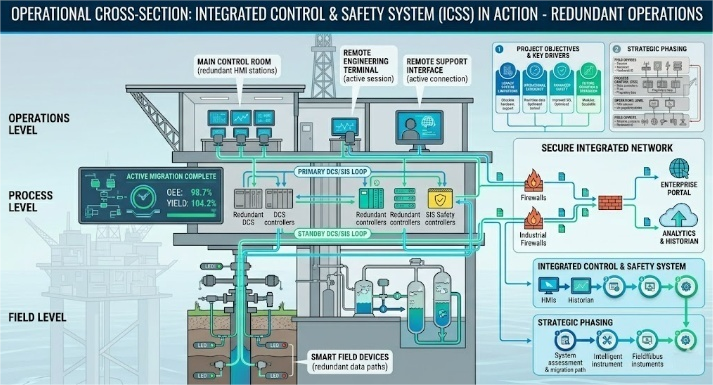
A Distributed Control System (DCS) is the central nervous system of offshore oil platforms, responsible for monitoring and controlling critical processes such as:
Crude oil separation and treatment
Gas compression and reinjection systems
Power generation and distribution
Produced water management
Emergency shutdown coordination
In offshore environments such as FPSO vessels and fixed platforms, DCS platforms ensure continuous, real-time process control across thousands of I/O points. According to industry studies, modern DCS architectures are designed for high availability, redundancy, and deterministic control, making them essential for safety-critical offshore operations .
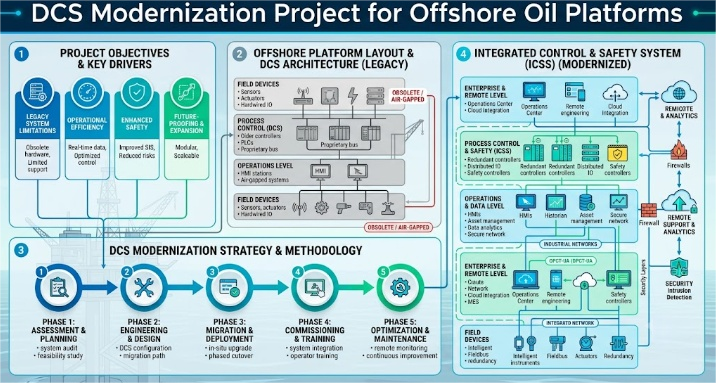
Many offshore facilities still operate on legacy DCS systems that are over 15–25 years old. These outdated systems introduce several operational risks:
Legacy controllers and I/O modules become increasingly difficult to source, increasing downtime risks and maintenance costs.
Modern offshore systems are increasingly connected to corporate networks and remote monitoring platforms, expanding the attack surface for cyber threats .
Older systems lack advanced diagnostics, predictive maintenance capabilities, and real-time optimization tools.
Legacy DCS platforms often struggle to integrate with modern SCADA, PLC, and IIoT-based systems, limiting digital transformation initiatives.
A successful DCS upgrade for offshore oil platforms focuses on the following core objectives:
Migration from obsolete control hardware to modern redundant controllers
Integration of advanced process control (APC) and predictive analytics
Enhanced alarm management and operator interface (HMI/SCADA upgrade)
Improved cybersecurity architecture based on IEC 62443 standards
Seamless integration with ICSS and safety instrumented systems (SIS)
Reduction of unplanned downtime through real-time diagnostics
Modern offshore DCS systems are designed with a multi-layer architecture:
Sensors, transmitters, valves, and actuators collecting real-time process data.
Distributed controllers executing PID loops, interlocks, and safety logic.
Operator stations, engineering workstations, and historian systems enabling monitoring and control.
Connectivity with cloud analytics, digital twins, and remote monitoring centers.
This layered architecture enables offshore operators to achieve both operational stability and digital transformation readiness.
Upgrading offshore systems presents unique engineering challenges:
Limited downtime windows during production cycles
Harsh environmental conditions (humidity, corrosion, vibration)
Complex legacy integration with vendor-specific protocols
Strict safety and classification regulations
High dependency on continuous production availability
Effective modernization strategies typically use phased migration or parallel system operation to ensure zero disruption.
Implementing a DCS modernization project for offshore oil platforms delivers measurable improvements:
Higher system reliability and uptime
Faster fault detection and diagnostics
Improved process optimization and yield efficiency
Enhanced emergency shutdown (ESD) response
Better alarm management and event tracking
Improved compliance with functional safety standards (IEC 61511)
Integration with Industrial IoT platforms
Real-time data analytics and predictive maintenance
Remote monitoring and cloud-based visualization
To improve online discoverability, the following high-search-volume SEO keywords are integrated into this article:
DCS modernization offshore oil platform
Distributed Control System upgrade
offshore automation systems
FPSO control system upgrade
industrial control system modernization
oil and gas automation solutions
legacy DCS migration strategy
SCADA and DCS integration offshore
industrial cybersecurity for oil platforms
process automation offshore industry
Easy Semiconductor Technology (Hong Kong) Limited specializes in industrial automation solutions, including DCS modernization, PLC integration, SCADA system optimization, and offshore control system upgrades. The company supports global clients in oil & gas, marine engineering, power generation, and heavy industrial sectors with advanced automation technologies and engineering services.
As offshore oil platforms evolve toward smarter, safer, and more connected operations, DCS modernization projects are becoming essential for long-term sustainability. Upgrading legacy control systems not only improves operational efficiency but also strengthens cybersecurity, enhances safety performance, and enables full digital transformation across offshore assets.