
 home
home
 Published: May 14, 2026 01:57 PM
 Page View: 298
In modern industrial automation, the Emerson Electric DeltaV Distributed Control System (DCS) has become one of the most widely used control platforms in industries such as oil & gas, power generation, chemicals, pharmaceuticals, and food processing. Known for its reliability, scalability, and advanced process control capabilities, the DeltaV system plays a critical role in maintaining plant safety and operational efficiency. However, like all complex automation systems, DeltaV may occasionally experience faults that require fast and accurate troubleshooting to minimize downtime and production losses.
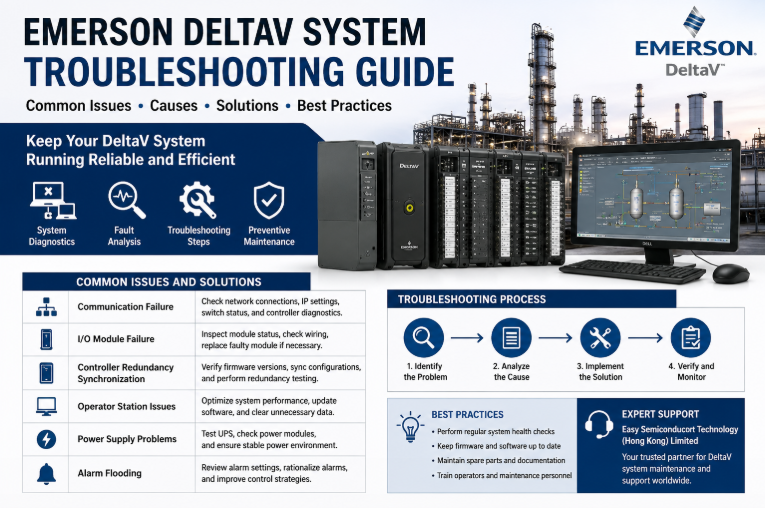
This troubleshooting guide from Easy Semiconductor Technology (Hong Kong) Limited provides practical solutions for common DeltaV system issues and helps maintenance engineers improve system stability and performance.
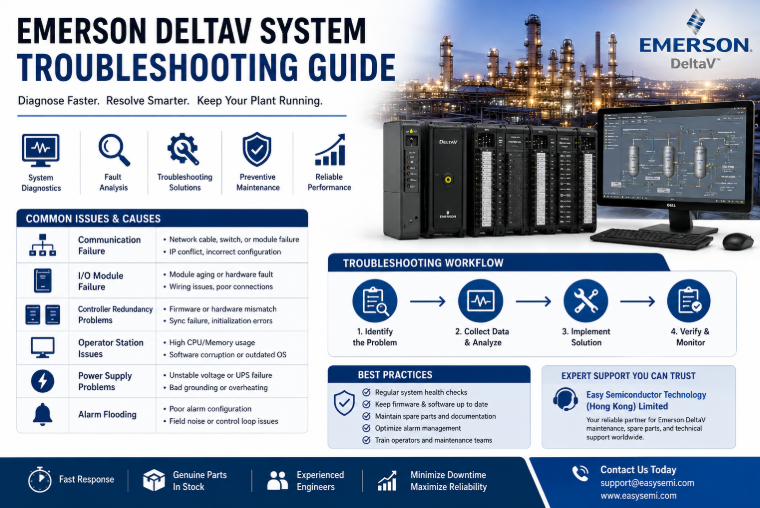
One of the most frequent problems in DeltaV systems is communication interruption between controllers, operator stations, and engineering workstations. This issue can lead to delayed process data, alarm failures, or complete loss of operator visibility.
Common causes include network cable damage, switch failures, IP address conflicts, controller redundancy mismatches, or faulty power supplies. Engineers should first inspect the physical network layer, including switches, fiber modules, and Ethernet cables. Checking controller status LEDs and DeltaV diagnostics is also essential.
In many cases, restarting the affected node and verifying network topology can quickly restore communication. Preventive maintenance should include regular switch inspections and backup configuration verification.
I/O cards are the foundation of field signal acquisition. When an I/O module fails, operators may lose critical process values such as temperature, pressure, flow, or valve position feedback.
Typical symptoms include frozen values, abnormal signal fluctuations, bad quality status, or complete signal disappearance. Causes often involve module aging, loose terminal connections, field wiring damage, or power supply instability.
The recommended troubleshooting process starts with checking the module diagnostics in DeltaV Explorer, followed by field terminal inspection and loop testing. Replacing faulty modules with tested spare parts is often the fastest recovery method. Easy Semiconductor maintains a large inventory of DeltaV spare modules to support urgent plant repairs.
DeltaV redundant controllers are designed to improve system reliability, but synchronization failure between primary and standby controllers can create significant operational risks.
This issue may occur due to firmware version mismatch, hardware incompatibility, memory corruption, or failed controller initialization. Operators may notice standby controller alarms or automatic switchover failures.
To resolve this, engineers should confirm that both controllers use identical firmware versions and hardware revisions. Redownloading controller configurations and performing controlled redundancy testing are highly recommended. In severe cases, module replacement may be necessary.
Slow operator stations, frozen graphics, delayed alarm displays, or application crashes can significantly affect plant operation and decision-making.
These problems are often caused by excessive historical data loading, insufficient workstation memory, antivirus conflicts, outdated operating systems, or software corruption. Maintenance personnel should regularly clean unnecessary historical logs, optimize display graphics, and verify system resource usage.
Keeping DeltaV software patches updated and ensuring hardware compatibility can greatly reduce workstation instability. Scheduled workstation health checks are strongly advised.
Stable power is essential for any DCS system. Power fluctuations can cause controller resets, module failures, communication interruptions, and even system-wide shutdowns.
Common issues include aging UPS batteries, unstable plant voltage, failed power modules, and poor grounding conditions. Engineers should regularly test UPS backup capacity, inspect grounding resistance, and monitor cabinet temperature to prevent overheating.
Installing redundant power supplies and maintaining clean electrical environments can significantly improve long-term system reliability.
Excessive alarms can overwhelm operators and reduce response efficiency during critical situations. Alarm flooding often results from poor alarm configuration, repeated field signal disturbances, or improper control loop tuning.
Troubleshooting should focus on identifying nuisance alarms, optimizing alarm priority settings, and improving control strategy design. DeltaV’s alarm management tools can help reduce unnecessary operator burden and improve plant safety.
A well-managed alarm system improves not only operational performance but also regulatory compliance in high-risk industries.
When major DeltaV failures occur, rapid diagnosis and professional support become crucial. Easy Semiconductor Technology (Hong Kong) Limited specializes in industrial automation maintenance, emergency spare parts supply, and system recovery services for DCS, PLC, turbine monitoring, and safety systems.
With extensive experience in Emerson Electric DeltaV systems, the company provides fast-response troubleshooting solutions, helping customers reduce downtime and restore production safely and efficiently.
The Emerson Electric DeltaV system remains one of the most trusted DCS platforms in industrial automation, but effective troubleshooting is essential to maintaining its performance and reliability. From communication failures and I/O faults to redundancy issues and power disturbances, understanding the root causes of common problems allows engineers to respond faster and more accurately.
With proper preventive maintenance and expert technical support, industrial plants can maximize DeltaV system uptime and ensure continuous, safe production operations.